Apigee vs F5 Distributed Cloud — Choosing the Right Front Door
Key takeaways: Apigee governs APIs as products — developer identity, quotas, mediation, portals. F5 XC delivers traffic to private backends — anycast entry, WAF, tunnels, multi-cloud load balancing. They share an HTTPS edge but solve different problems. Use Apigee when the consumer is a developer, F5 XC when the problem is the network and perimeter, and both when a governed API product must sit behind an edge WAF with private origins.
Both platforms appeared in earlier material: Apigee as the private API entry point in the GKE case study, and F5 XC across stages 17–19. This page is the bridge: same front-door position, different jobs.
Same surface, different questions
| Question your design asks | Owner |
|---|---|
| Which developer/app may call this API, how much, under which product? | Apigee |
| Is this request malicious, and which private origin may serve it? | F5 XC |
| How do backends with no public IP become reachable? | F5 XC |
| How do consumers discover APIs and get keys without asking you? | Apigee |
| How do GCP, AWS, and a data center share one policy fabric? | F5 XC |
| How does a SOAP backend answer a REST consumer? | Apigee |
What each actually is
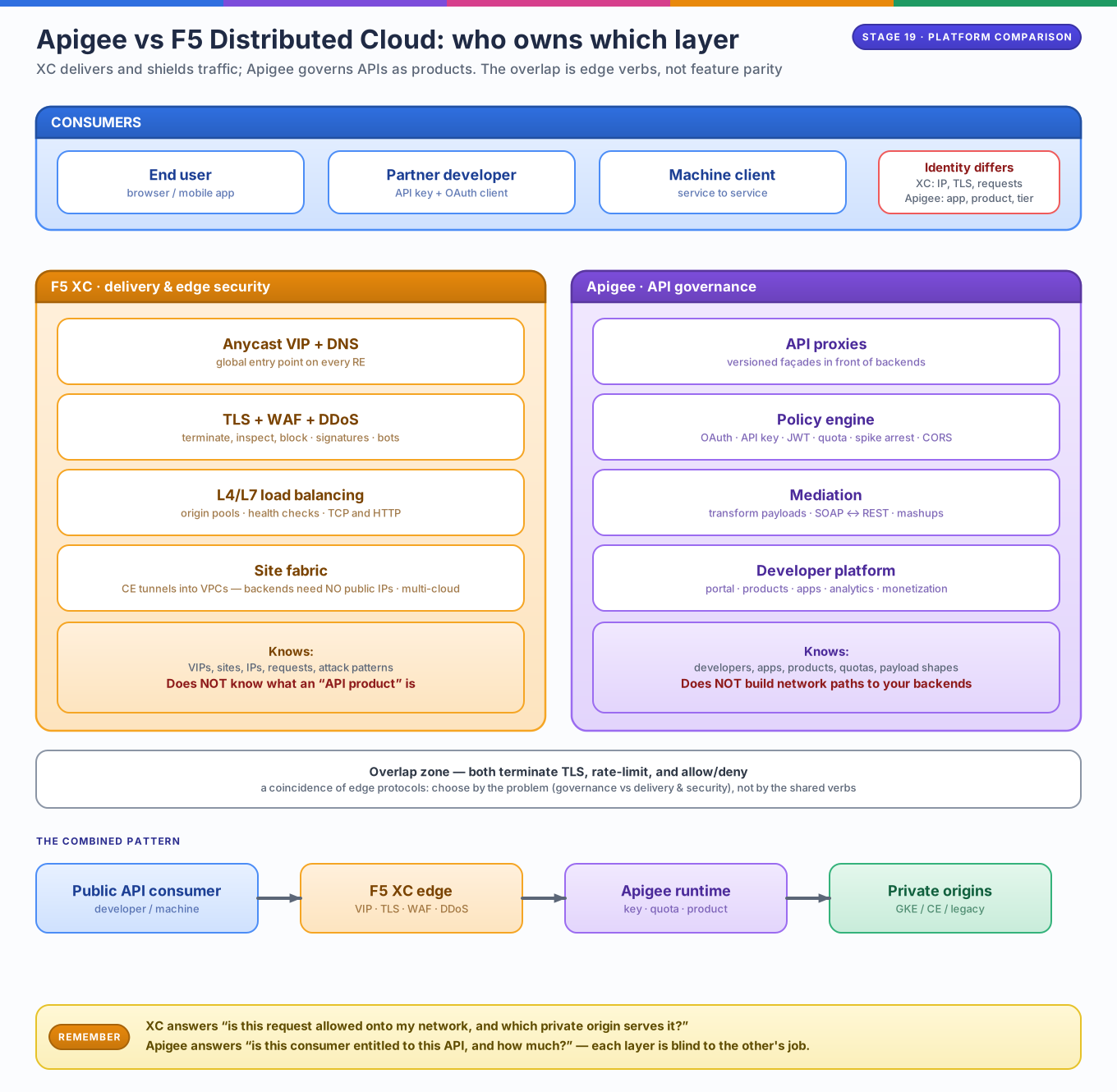
Apigee — an API management platform. API proxies are versioned façades; policies verify OAuth/JWT/API keys, enforce quota and spike arrest, transform payloads (SOAP↔REST, XML↔JSON), and a developer portal lets consumers self-serve docs and keys. Products, apps, analytics, and monetization make APIs a managed offering. Identity is the developer and the app.
F5 XC — an edge delivery and security fabric. Regional Edges terminate clients on anycast VIPs, WAF/DDoS inspects requests, load balancers pick origin pools, and Customer Edges tunnel into your VPCs so backends need zero public IPs — across GCP, AWS, or a data center. Identity is the site and the request.
Where they overlap — and where they don't
| Capability | Apigee | F5 XC |
|---|---|---|
| Terminate TLS / HTTPS | ✅ | ✅ |
| Rate limiting / quotas | ✅ per-developer, per-product | ✅ per-source, per-endpoint |
| AuthN on requests | ✅ OAuth, JWT, API key | ✅ JWT/mTLS on LB (lighter) |
| WAF (signatures, bots, campaigns) | ⚠️ basic threat policies only | ✅ core strength |
| Load balance across sites/clouds | ❌ | ✅ |
| Reach private backends with no public IP | ⚠️ only via peering/private connect you build | ✅ CE tunnel is the product |
| Non-HTTP (TCP) traffic | ❌ | ✅ |
| Developer portal / API products / monetization | ✅ | ❌ |
| Payload mediation & transformation | ✅ | ❌ |
| Site-to-site mesh between your clouds | ❌ | ✅ |
The overlap (TLS, rate limit, allow/deny) is a protocol coincidence, not feature parity — Apigee's limits are about entitlement economics, XC's are about abuse prevention.
What's good under which scenario
| Scenario | Pick | Why |
|---|---|---|
| Partner developer API with keys, docs, quota tiers | Apigee | Portal + products + per-consumer metering are built for exactly this |
| Monetized/open API program | Apigee | Monetization and analytics exist nowhere in XC |
| Legacy SOAP service behind a modern REST façade | Apigee | Mediation/transform policies are its specialty |
| Private web app for end users, backends must stay dark | F5 XC | CE tunnels + anycast VIP + WAF in one product |
| Same security posture across GCP + AWS + DC | F5 XC | One control plane, one WAF policy, every site |
| TCP/non-HTTP workload exposure | F5 XC | Apigee speaks HTTP APIs only |
| Lift-and-shift needing WAF for PCI/compliance fast | F5 XC | Publish + WAF in minutes; no developer portal tax |
| Internal-only microservice traffic | Neither | Use GCLB/service mesh — don't buy an edge for east-west |
| Public API product + private origins + edge WAF | Both | XC shields and delivers, Apigee governs and meters |
The combined pattern
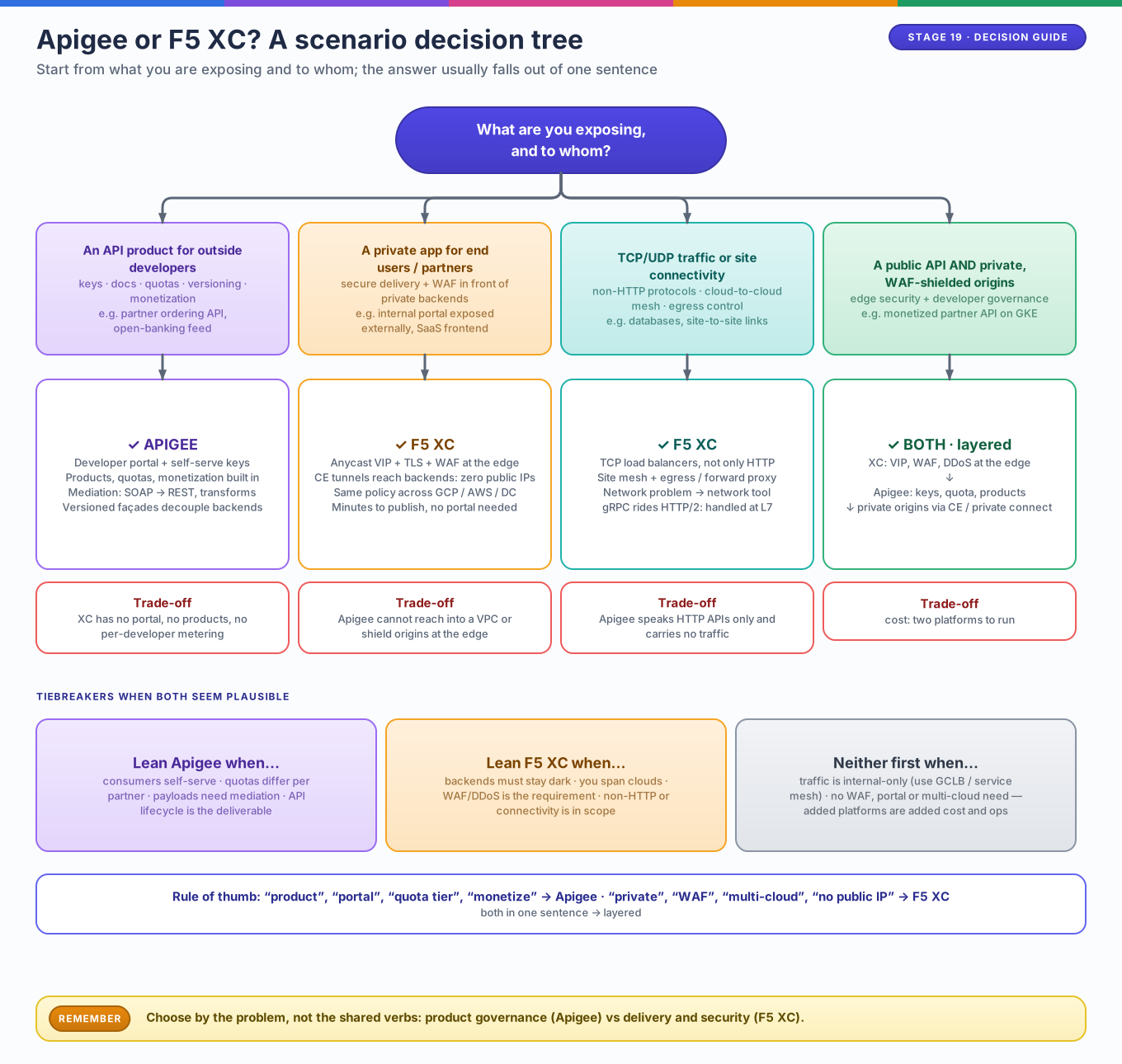
When a governed API product needs a security perimeter and private origins, stack them — XC at the edge, Apigee inside:
consumer → [F5 XC: VIP + TLS + WAF + bot/geo policy]
         → [Apigee: API key + quota + product + mediation]
         → [private origins: GKE / CE / legacy — still zero public IPs]
Each layer is blind to the other's job. In the case study, Apigee is privately exposed and clients arrive over IPsec VPN — the combined pattern replaces that VPN requirement with an XC edge for public-facing scenarios while keeping Apigee's governance.
Anti-patterns
- Apigee as the security perimeter. Threat policies ≠ WAF. Putting Apigee directly on the internet as your only defense misses DDoS absorption, attack signatures, and bot management.
- XC load balancer as API management. No portal, no products, no per-developer quotas — you'll rebuild Apigee badly in service policies.
- XC CE for internal-only traffic. East-west traffic inside one VPC doesn't need a global edge network; it's cost and hops without benefit.
- Apigee for non-HTTP workloads. It is an HTTP API platform; databases, custom TCP, and site connectivity are out of scope.
Rule of thumb
Apigee is bought for the developer relationship; F5 XC is bought for the network + security perimeter. Sentence contains "product", "portal", "quota tier", "monetize" → Apigee. Contains "private", "WAF", "multi-cloud", "no public IP" → F5 XC. Both → layered.
Map it back
- Apigee's private-exposure model: GKE case study
- XC platform & edge roles: Stage 17
- XC private-origin delivery: Stage 18, Stage 19
- Hands-on XC: F5 XC labs