Stage 19: F5 XC Origins, Load Balancing & Security
Key takeaways: In XC the origin pool owns "where backends are and how to reach them," the health check owns "who is allowed to serve," the HTTP load balancer owns "which clients reach which pools and under what policy," and the app firewall is the WAF attached to the LB. A request survives six decisions between DNS and the private origin.
Origin pool — the routing contract
An origin pool answers three questions:
| Question | Field (Terraform shape) | Lab value |
|---|---|---|
| Who are the backends? | origin_servers → private_ip / k8s_service / public_ip / discovered endpoint |
10.200.0.10 |
| Reached how? | inside_network / outside_network + site_locator |
inside, site gcp-xc-lab |
| On what port & policy? | port, no_tls/use_tls, endpoint_selection, loadbalancer_algorithm |
80, LOCAL_PREFERRED, LB_OVERRIDE |
The inside_network flag is the security-relevant line — it means "deliver
through the CE's SLI interface." Pointing at outside_network sends the REs'
traffic down the public side, which is usually both wrong and unreachable.
endpoint_selection controls whether only the local site's endpoints serve
(LOCAL_ONLY), local is preferred with remote failover (LOCAL_PREFERRED), or
any site may serve (DISTRIBUTED).
Health checks
Independent objects referenced by pools. An HTTP check (GET /) verifies the
application; a TCP check verifies the listener. Pools only send traffic to
healthy endpoints — a dead origin produces 503/no-healthy-upstream responses
at the RE before any client bytes reach your site. Match the check to what
"healthy" means: a TCP check passes on a crashed-but-listening app; HTTP 200 on
/ is stronger.
HTTP load balancer — anatomy
| Concern | Field(s) | Notes |
|---|---|---|
| Hostname | domains[] |
Must be DNS-answerable: delegated to XC or CNAME'd to the LB's VIP hostname |
| Exposure | advertise_on_public_default_vip / custom VIP / do_not_advertise |
Public VIP = reachable at every RE; do_not_advertise for internal testing |
| Routing | default_route_pools (or routes for path/host rules) |
The pool(s) requests fall through to |
| Transport | http / https / https_auto_cert |
Auto-cert needs XC-managed DNS to complete ACME |
| Stickiness/algo | round_robin / least_active / source_ip_stickiness … |
Per-LB choice |
| Policy | app_firewall ref, service_policies, rate_limit, *_challenge |
The security stack attached at the edge |
A newer provider quirk worth knowing: many "feature off" choices
(disable_api_discovery, no_challenge, disable_rate_limit, …) are
required one-of groups — you must explicitly pick off/on rather than
leaving them unset. That is why Lab 04's LB block lists so many disable_*
lines.
The security stack — three enforcement layers
| Layer | Object | Evaluates | Typical lab use |
|---|---|---|---|
| Edge WAF | volterra_app_firewall |
Signatures, threat campaigns, bot classes, attack types — returns a block page with support ID | blocking mode with default detection |
| Service policy | volterra_service_policy |
L7 allow/deny rules (path, method, headers, geo, ASN, IP reputation) | Deny /admin, allow-list partners |
| Site network policy | active_network_policies / enhanced firewall on the site |
L3/L4 rules inside the site fabric | Restrict what the CE may reach SLI-side |
WAF modes: monitoring (log only), blocking (log + block). Start a new app
in blocking only if you accept false-positive tuning work; monitoring
first is the safer rollout for real apps.
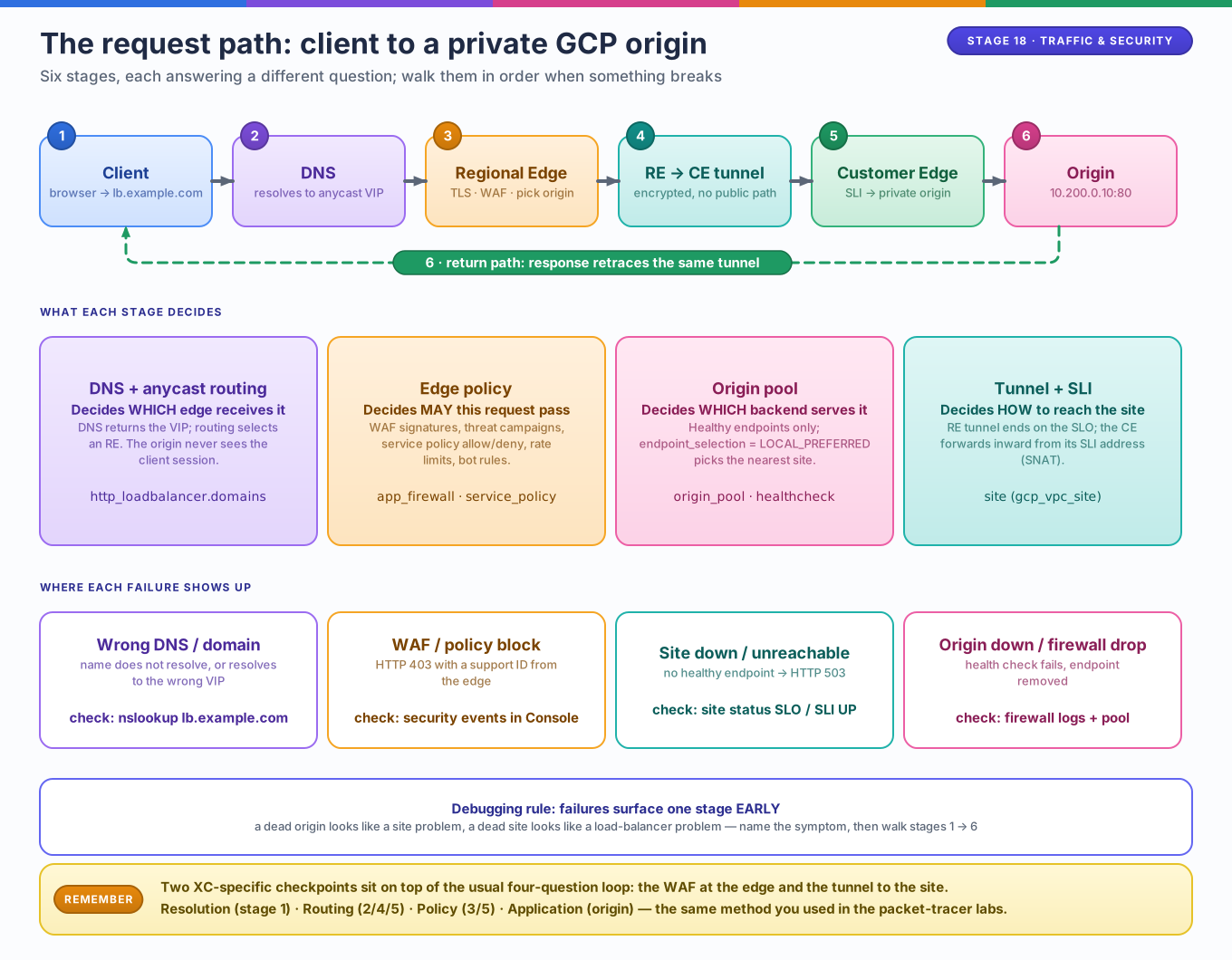
Where each failure shows up
| Symptom | Stage | First check |
|---|---|---|
| Domain won't resolve | 1 | domains[] value, delegated DNS/CNAME |
| TLS/cert errors | 2 | https_auto_cert vs delegated DNS, or BYO cert |
| 403 + support ID | 3 | Security event log; WAF mode/signatures |
| 503 no healthy upstream | 4/5 | Site SLO/SLI UP? health check passing? |
| Timeouts to origin | 5 | GCP firewall rule, inside/outside flag on pool |
| Right page, wrong client IP in logs | — | enable_trust_client_ip_headers + app reads X-Forwarded-For |
Same four questions, two new checkpoints
The learning-path loop — Resolution · Routing · Policy · Application — still applies. XC adds two policy checkpoints: the edge WAF (stage 3) and the tunnel/site health (stage 4). Symptoms name the layer: 403-support-ID is policy, 503-no-upstream is reachability.
Map it to the labs
- Lab 02 clicks through pool → LB → WAF in the Console.
- Lab 04 encodes all of it:
volterra_healthcheck,volterra_origin_pool,volterra_app_firewall,volterra_http_loadbalancer. - Extend with
volterra_discoveryto let GCP labels/GKE services populate endpoints dynamically, andvolterra_service_policyfor allow/deny rules beyond the WAF.