00 · Architecture Decision Framework & IPAM Blueprint
Train Your Architect Brain: In interviews, design reviews, and production incidents, knowing how to run a command is 20% of the job; knowing why an boundary exists, what fails when it's misconfigured, and when to choose an alternative is the other 80%.
1. Master IPAM Blueprint (Memorize This Table)
Pod and Service CIDRs are baked in at cluster creation and painful to change later. Always allocate four distinct address classes before touching Docker, Minikube, or Terraform.
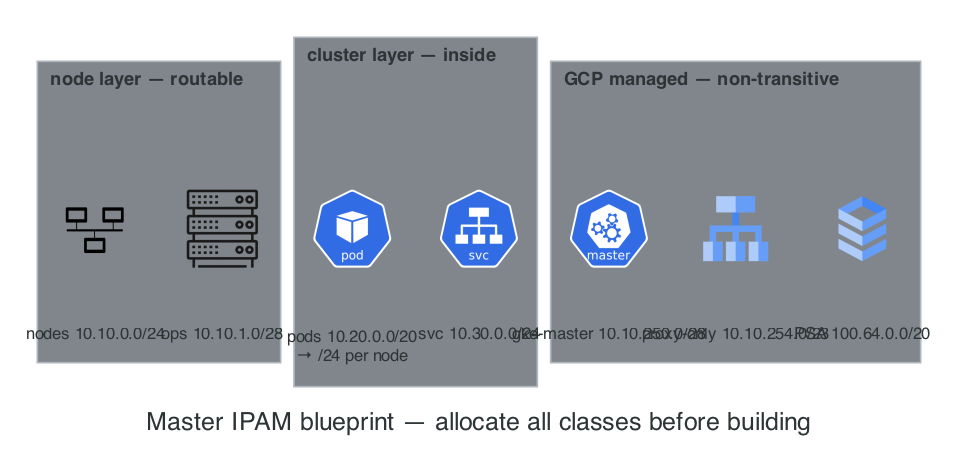
| Address Space | CIDR | Total IPs | Per-Node / Purpose | Who Allocates It? | Routable Outside Cluster? | GCP Equivalent |
|---|---|---|---|---|---|---|
| Primary Node Subnet | 10.10.0.0/24 |
254 | .10 .11 .12 (Minikube Nodes).200 (Registry), .240-.249 (MetalLB), .250 (Router) |
Docker Bridge / GCP Subnet | Yes (Advertised over VPN/NCC) | google_compute_subnetwork.gke_main |
| Ops / Bastion Subnet | 10.10.1.0/28 |
14 | .2 (Router), .3 (probe container) |
Docker Bridge / GCP Subnet | Yes | google_compute_subnetwork.ops |
| Pod CIDR | 10.20.0.0/20 |
4,096 | /24 per node locally (16 nodes max)/25 on GKE (max_pods_per_node=64 → 32 nodes max) |
kube-controller-manager (node.spec.podCIDR) + Cilium |
No locally (SNAT'd to Node IP) VPC-only on GKE (SNAT'd to On-Prem unless ip-masq-agent configured) |
secondary_ip_range gke-pods |
| Service CIDR | 10.30.0.0/24 |
254 | .1 (kubernetes.default), .10 (kube-dns) |
kube-apiserver |
Never (Virtual IPs rewritten in kernel by eBPF/iptables) | secondary_ip_range gke-svcs |
| GKE Master CIDR | 10.10.250.0/28 |
14 | Google-managed control plane VPC peering | GKE Control Plane | VPC Peered (Non-transitive) | master_ipv4_cidr_block |
| Proxy-Only Subnet | 10.10.254.0/23 |
512 | Regional Envoy proxies for gke-l7-rilb |
Google Managed Proxy Fleet | Internal to Region | purpose = "REGIONAL_MANAGED_PROXY" |
| PSA Peering | 100.64.0.0/20 |
4,096 | Cloud SQL Private IP (servicenetworking) |
Google Service Producer | Non-transitive VPC Peering | purpose = "VPC_PEERING" (RFC 6598 saves 10.x) |
The 3 Golden IPAM Rules for Architects
- Node Capacity Is Often Capped by Pod CIDR, Not Node Subnet: A
/20Pod CIDR has sixteen/24blocks. With default Kubernetes settings (--node-cidr-mask-size=24, up to 110 pods/node), your cluster cannot scale past 16 nodes even if your node subnet has 250 free IPs! On GKE, settingmax_pods_per_node = 64shrinks the slice to/25(128 IPs), doubling max nodes to 32. - Overlap Is Silent Until You Connect Networks: Two clusters with
10.20.0.0/20run fine in isolation. The day you peer their VPCs or attach them to Cloud Router/VPN, routing breaks catastrophically. - Never Burn
10.xon Managed Databases: Use RFC 6598 (100.64.0.0/10) for Private Services Access (Cloud SQL) so enterprise10.xranges remain clean for VPCs and on-prem spokes.
Regional Extension (Lab 11 · Option B)
When a second cluster is justified (see ADR-01), each region gets a self-contained slice of the blueprint — third-octet = region index for nodes, +10 for pods, +20 for services. Allocate all rows before peering.
| Region | Profile | Node Subnet | Pod CIDR | Service CIDR | Cilium cluster.id |
Domain |
|---|---|---|---|---|---|---|
| us (hub) | acme |
10.10.0.0/24 (acme-main) |
10.20.0.0/20 |
10.30.0.0/24 |
1 | orders |
| eu | acme-eu |
10.11.0.0/24 (acme-eu) |
10.21.0.0/20 |
10.31.0.0/24 |
2 | payments |
| asia | acme-asia |
10.12.0.0/24 (acme-asia) |
10.22.0.0/20 |
10.32.0.0/24 |
3 | inventory |
All acme-* subnets live inside 10.8.0.0/13 — one route per node sends every region through its local vpc-router leg (10.1x.0.250), the NCC hub-spoke twin.
2. Core Architectural Decision Records (ADRs)
ADR-01: Multi-Domain Isolation — 1 Shared Cluster vs 3 Separate Clusters
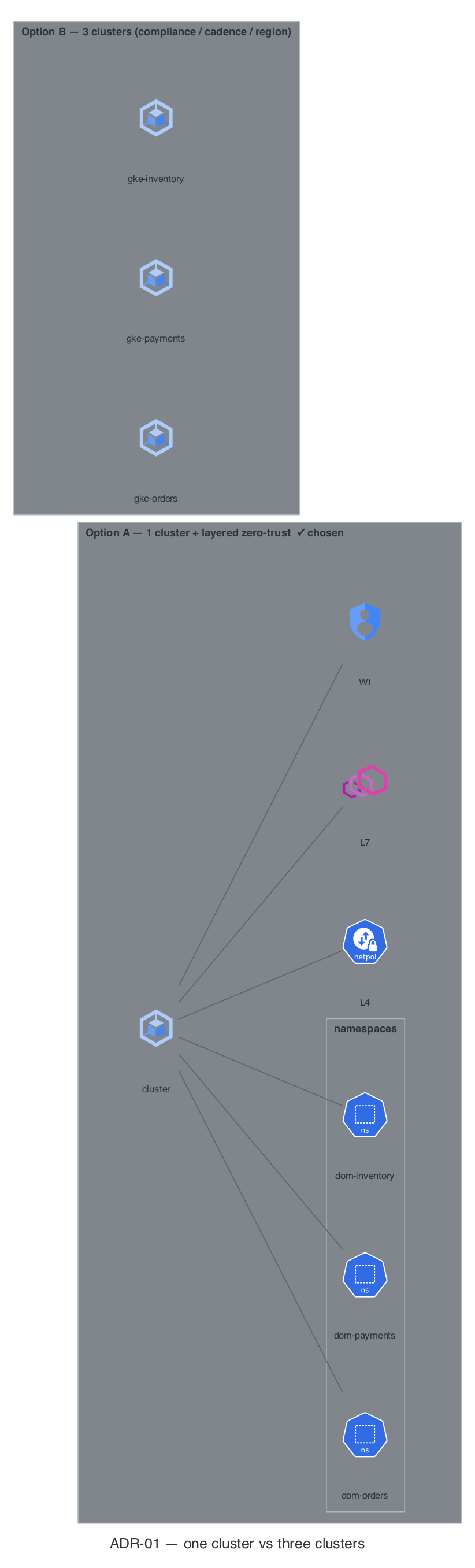
| Dimension | Option A: 1 Cluster + Layered Zero-Trust (Chosen) | Option B: 3 Clusters in 3 VPCs |
|---|---|---|
| Control Plane & Node Cost | 1x (Fits free-tier zonal credit; high bin-packing density) | 3x management fees, 3x idle node headroom, 3x Istio/Flux control planes |
| East-West Latency | Sub-millisecond (Same VPC, Cilium eBPF direct routing) | Requires VPC Peering / NCC / Private Service Connect + cross-cluster ingress |
| Security Boundary | Defense-in-Depth: L4 eBPF (NetworkPolicy) + L7 Crypto Identity (SPIFFE) + Cloud IAM (Workload Identity) |
Hard kernel/VPC boundary |
| When to Switch to Option B? | — | When regulatory compliance (PCI-DSS CDE vs non-CDE) mandates separate VPC firewall tables or teams require independent GKE upgrade cadences. (Compromise: Per-domain node pools with dedicated pod secondary ranges in 1 cluster). |
| Where is Option B hands-on? | — | Lab 11 · Multi-Region Federation & ClusterMesh builds it end-to-end: region-up.sh cluster factory + NCC hub-spoke twin + Cilium ClusterMesh (MCS twin). |
ADR-02: CNI Selection — Cilium eBPF (Dataplane V2) vs Calico vs Kindnet
| Feature | Kindnet / Bridge | Calico (iptables) | Cilium eBPF / GKE Dataplane V2 (Chosen) |
|---|---|---|---|
Enforces NetworkPolicy? |
No (Silently ignores policies!) | Yes (via Linux iptables/ipsets) |
Yes (In-kernel eBPF programs) |
| Service Load Balancing | kube-proxy iptables (O(N) rule scan) |
kube-proxy iptables / IPVS |
eBPF socket-level bypass (O(1) hash lookup) |
| Observability | Blind (tcpdump only) |
Paid Enterprise or basic logs | Hubble CLI/UI built-in (hubble observe --verdict DROPPED) |
| GCP Parity | None | Legacy GKE Network Policy | Exact engine powering GKE Dataplane V2 (ADVANCED_DATAPATH) |
ADR-03: Service Mesh — Istio Sidecar Mode vs Ambient Mode vs No Mesh
| Requirement | No Mesh (CNI Only) | Istio Ambient Mode (ztunnel) | Istio Sidecar Mode (Chosen for Training) |
|---|---|---|---|
| Caller Identity | IP Address / Pod Label only (Spoofable if CNI bypassed) | Cryptographic SPIFFE X.509 (cluster.local/ns/.../sa/...) |
Cryptographic SPIFFE X.509 (cluster.local/ns/.../sa/...) |
| L7 HTTP Path/Method Policy | Limited (Cilium L7 requires Envoy DaemonSet) | Requires deploying Waypoint proxies | Every pod has dedicated istio-proxy (Envoy) |
| Why Chosen Here? | Lacks mTLS & SPIFFE | Hides pod-level networking mechanics | Exposes real enterprise failure modes: webhook ordering, 15012 xDS egress, 1/2 Ready traps, and STRICT mTLS vs plaintext LBs. |
ADR-04: Observability — Why 3 Telemetry Patterns in a 4-Container Pod?
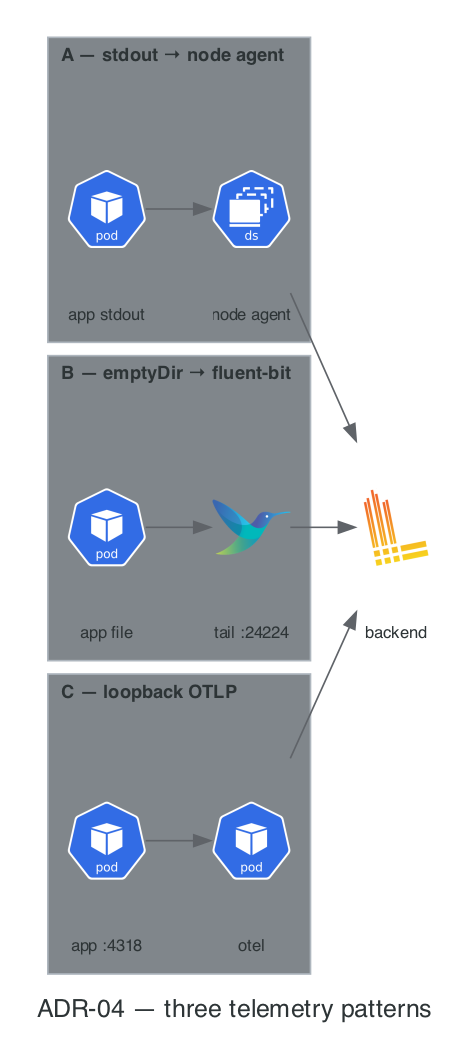
| Pattern | Mechanism | Pros | Cons / Network Trap |
|---|---|---|---|
Pattern A: stdout → Node Agent |
App & Envoy write JSON to stdout; Kubelet writes /var/log/containers; node DaemonSet ships it. |
Zero pod RAM overhead; works even if pod egress is locked down. | Runs under Node SA, not Pod SA; noisy neighbor on node disk can drop logs. |
Pattern B: Shared emptyDir + fluent-bit Sidecar |
App writes /var/log/app/app.log; fluent-bit tails file, enriches metadata, ships directly. |
Works for legacy apps that only log to files; uses Pod's Workload Identity. | Costs ~32Mi RAM/pod; breaks under Default-Deny Egress unless collector/API port + metadata server (169.254.169.252:988) are allowed! |
Pattern C: Loopback OTLP + otel-collector Sidecar |
App sends traces/logs/metrics to 127.0.0.1:4318; OTel batches, redacts PII, exports to backend. |
Vendor-neutral (swap debug exporter for googlecloud with 1 line); offloads batching/retries from app. |
Costs ~64Mi RAM/pod; requires egress hole to telemetry backend. |
ADR-05: Ownership Boundary — Terraform vs FluxCD Handshake
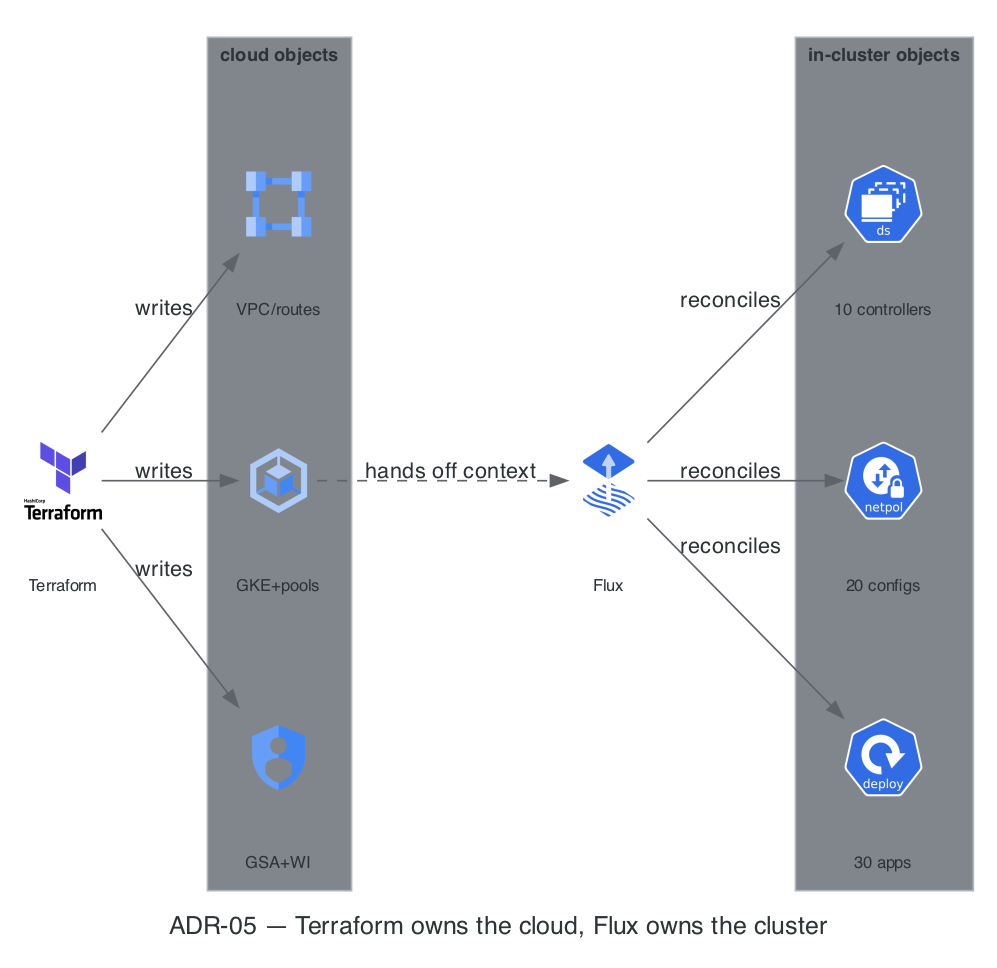
- Rule: Terraform never runs
kubectl applyor uses the Kubernetes/Helm Terraform providers. - Why?
- Security: GitLab CI runners never need network access to the private GKE control plane (
10.10.250.0/28). Flux pulls from inside the cluster out to GitLab over Door 3 (Cloud NAT). - State Reliability: Broken Kubernetes CRDs inside Terraform state wedge
terraform plan/destroy. Separating infrastructure (Terraform) from workloads (Flux) via deterministic names (orders-app@<project>.iam.gserviceaccount.com) eliminates circular dependencies.
ADR-06: The dom-data Tier — One Shared DB (orders+inventory), One Private DB (payments)
- Rule: All databases live in a dedicated
dom-datanamespace, outside every domain's trust boundary and outside the Istio mesh (no sidecar injection).ordersandinventorysharecommerce-db(schemassales+inventory);paymentsownspayments-dbalone. - Why the shared schema for orders+inventory?
- Atomicity: "place order = decrement stock + insert order row" must be one ACID transaction. An HTTP
POST /reservehop between services cannot share a transaction boundary — you'd need two-phase commit for what aBEGIN…COMMITgives free. - Honest trade-off (shared fate):
orders_rwis grantedUPDATEoninventory.itemsbut notINSERT/DELETE— the shared-schema tension is intentional and debatable: coupling vs consistency. Whencommerce-dbdies, both domains degrade — that blast radius is the lesson, not an accident. - Why
paymentsdoes NOT share: payment records are the highest-sensitivity data; a separate instance means a compromisedorders_rwrole cannot read card flow, andorders → payments-db:5432is verifiably dropped at L4. - Why no mesh on
dom-data: IstioAuthorizationPolicyenforces at the server-side Envoy — DB pods have none, and pgwire has no HTTP semantics anyway. The data tier is protected byNetworkPolicy(L4) alone; on GCP the identity gap is closed by Cloud SQL Auth Proxy + IAM DB auth, not by mesh mTLS.