Lab 06 · L7 Zero-Trust Guard: Istio Sidecars, STRICT mTLS & SPIFFE AuthZ
Core Lesson: NetworkPolicy (L3/L4) only checks where a packet comes from (IP/Namespace), not who is calling. If a rogue pod (
intruder) lands insidedom-orders, NetworkPolicy lets it callpaymentsfreely! Here you will add Istio sidecar proxies (istio-proxy), fix the classic1/2 ReadyxDS egress trap, enforceSTRICTmTLS, lockpaymentsdown to the cryptographic SPIFFE identitycluster.local/ns/dom-orders/sa/orders— and see exactly where L7 identity ends: at the TCP border of thedom-datatier.
GCP Twin: Phase P5 & P7 (istiod,PeerAuthentication,AuthorizationPolicy) — and Cloud SQL Auth Proxy, which is how GCP restores identity inside the DB connection that the mesh can't see.
1. Architecture Decision: Why Combine L4 NetworkPolicy AND L7 AuthorizationPolicy?
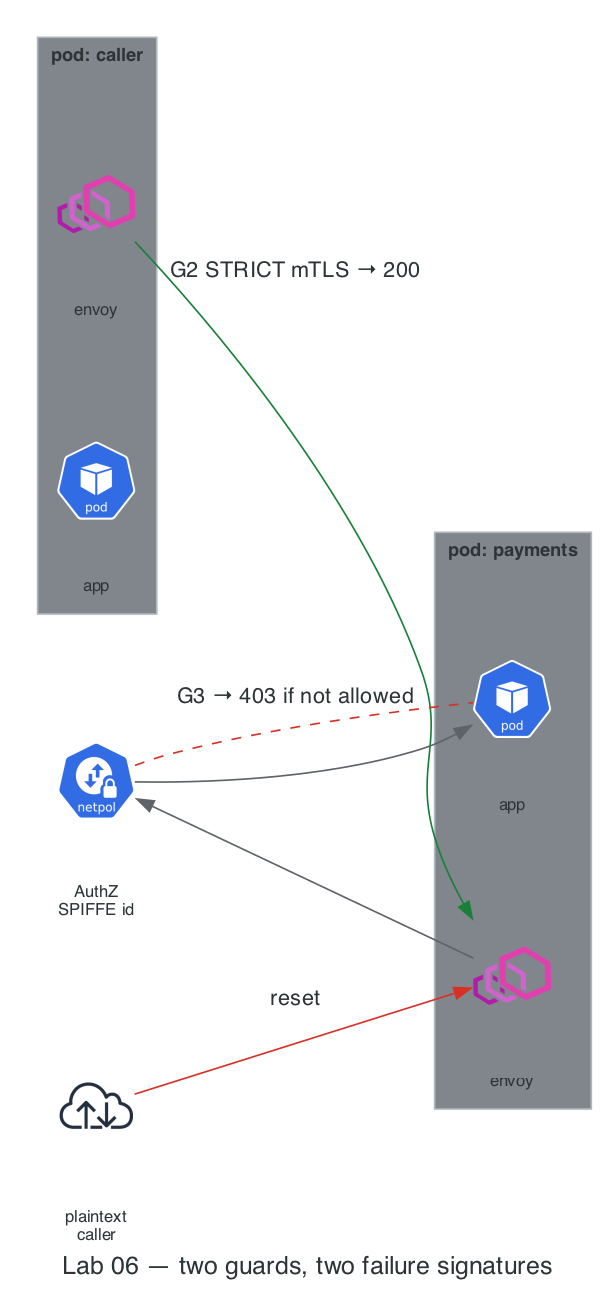
| Security Layer | Enforced By | What It Checks | Failure Signature |
|---|---|---|---|
| Guard 1 (L3/L4) | Cilium eBPF (NetworkPolicy) |
Pod IP / Namespace label + TCP Port 8080 |
Timeout (wget: download timed out) |
| Guard 2 (L4/L7 Crypto) | Envoy Sidecar (PeerAuthentication: STRICT) |
Valid X.509 mTLS client certificate signed by istiod Citadel CA |
Connection Reset (Connection reset by peer / empty reply) |
| Guard 3 (L7 Identity) | Envoy Sidecar (AuthorizationPolicy) |
SAN field inside X.509 cert (spiffe://cluster.local/ns/dom-orders/sa/orders), HTTP verb/path |
HTTP 403 (RBAC: access denied) |
2. Step-by-Step Hands-On Build
Step 1: Install Istio (Sidecar Mode) & Enable Namespace Injection
We deliberately use Sidecar Mode (profile=minimal) with JSON access logging to stdout (matching GKE Phase P5):
# 1. Install istiod control plane
task lab06:istio   # istioctl minimal + JSON access logs + waits for istiod,
                   # then labels dom-orders/dom-payments/dom-inventory for injection
                   # NOTE: dom-data stays OUT of the mesh on purpose — see Step 5.

# 3. Check pods BEFORE restarting deployments: Notice they are still 1/1!
kubectl get pods -n dom-orders
Nuance #1 Revealed: Mutating Admission Webhooks run only at Pod creation time. Labeling a namespace does nothing to running pods until they are recreated!
Now trigger a rollout restart across the 3 domains:
Step 2: Diagnose & Fix Break #1 — Pods Stuck at 1/2 Ready!
Wait 15 seconds and inspect the pods in dom-orders:
Why are the pods stuck at 1/2 Ready?
In Lab 05, we applied default-deny Egress to dom-orders, dom-payments, and dom-inventory! The newly injected istio-proxy container must connect to istiod.istio-system.svc:15012 (xDS config & certificate signing) before its readiness probe (:15021/healthz/ready) turns green. Cilium is dropping port 15012!
sequenceDiagram
    participant Proxy as istio-proxy (in dom-orders)
    participant Cilium as Cilium Egress NetPol
    participant Istiod as istiod (in istio-system :15012)

    Proxy->>Cilium: TCP SYN -> istiod.istio-system:15012 (xDS / CA CSR)
    Cilium--xProxy: DROPPED by default-deny! (Pod stays 1/2 Ready)
    Note over Cilium: Fix: Apply allow-istiod Egress Policy (:15012, :15014)
    Proxy->>Istiod: xDS Connected + X.509 SPIFFE Cert Issued
    Note over Proxy: Readiness Probe 200 OK -> Pod becomes 2/2 Ready!
Prove it in Hubble, then apply the allow-istiod Egress policy across all 3 domains:
# 1. Prove the drop in Hubble
kubectl -n kube-system exec ds/cilium -- hubble observe --to-port 15012 --verdict DROPPED --last 5

# 2. Allow egress to istio-system on TCP 15012 & 15014 in all 3 domains
for ns in dom-orders dom-payments dom-inventory; do
kubectl apply -f - <<EOF
apiVersion: networking.k8s.io/v1
kind: NetworkPolicy
metadata:
  name: allow-istiod
  namespace: $ns
spec:
  podSelector: {}
  policyTypes:
    - Egress
  egress:
    - to:
        - namespaceSelector:
            matchLabels:
              kubernetes.io/metadata.name: istio-system
      ports:
        - protocol: TCP
          port: 15012
        - protocol: TCP
          port: 15014
EOF
done

# 3. Verify all pods converge to 2/2 Ready and SYNCED in istioctl!
for ns in dom-orders dom-payments dom-inventory; do
  kubectl -n "$ns" rollout status deploy --timeout=120s
done
istioctl proxy-status
Step 3: Enforce STRICT mTLS & Prove the Plaintext Rejection Signature
By default, Istio runs in PERMISSIVE mode (accepts both mTLS and plaintext). Let's lock dom-payments and dom-inventory to STRICT mTLS:
for ns in dom-orders dom-payments dom-inventory; do
kubectl apply -f - <<EOF
apiVersion: security.istio.io/v1
kind: PeerAuthentication
metadata:
  name: default
  namespace: $ns
spec:
  mtls:
    mode: STRICT
EOF
done
Now test what happens when a non-mesh plaintext pod (in the default namespace) is allowed through the L4 NetworkPolicy and tries to call payments:
# 1. Temporarily open an L4 NetworkPolicy hole from 'default' namespace -> dom-payments:8080
kubectl apply -f - <<'EOF'
apiVersion: networking.k8s.io/v1
kind: NetworkPolicy
metadata: { name: tmp-allow-default, namespace: dom-payments }
spec:
  podSelector: {}
  policyTypes: [Ingress]
  ingress:
  - from: [{ namespaceSelector: { matchLabels: { kubernetes.io/metadata.name: default } } }]
    ports: [{ protocol: TCP, port: 8080 }]
EOF

# 2. Call payments from an un-meshed pod in 'default':
#    Observe the signature: "curl: (56) Recv failure: Connection reset by peer"
kubectl run plain-caller --rm -i --restart=Never --image=curlimages/curl --image-pull-policy=Never -- \
  -sS -m 4 http://payments.dom-payments/ || echo "EXPECTED: Connection reset by STRICT mTLS!"

# 3. Remove the temporary L4 hole
kubectl -n dom-payments delete netpol tmp-allow-default
Step 4: Enforce L7 SPIFFE AuthorizationPolicy (Stop the Same-Namespace Intruder)
Now deploy an intruder pod inside dom-orders using ServiceAccount: intruder. Because intruder is inside dom-orders and has a valid Istio sidecar, it passes both Guard 1 (NetworkPolicy) and Guard 2 (STRICT mTLS)!
# 1. Deploy 'intruder' inside dom-orders
kubectl apply -f - <<'EOF'
apiVersion: v1
kind: ServiceAccount
metadata: { name: intruder, namespace: dom-orders }
---
apiVersion: apps/v1
kind: Deployment
metadata: { name: intruder, namespace: dom-orders }
spec:
  replicas: 1
  selector: { matchLabels: { app: intruder } }
  template:
    metadata: { labels: { app: intruder } }
    spec:
      serviceAccountName: intruder
      containers:
      - name: app
        image: nginxinc/nginx-unprivileged:alpine
        imagePullPolicy: IfNotPresent
EOF

# Also allow intruder pod in dom-orders to egress to dom-payments:8080 at L4 so we test L7 alone
kubectl -n dom-orders patch netpol orders-egress -p '{"spec":{"podSelector":{}}}'
kubectl -n dom-orders rollout status deploy/intruder --timeout=90s

# 2. Apply L7 AuthorizationPolicy on dom-payments and dom-inventory:
#    ONLY allow SPIFFE principal "cluster.local/ns/dom-orders/sa/orders"
for d in payments inventory; do
kubectl apply -f - <<EOF
apiVersion: security.istio.io/v1
kind: AuthorizationPolicy
metadata:
  name: only-orders-sa
  namespace: dom-$d
spec:
  action: ALLOW
  rules:
    - from:
        - source:
            principals:
              - "cluster.local/ns/dom-orders/sa/orders"
EOF
done
Now run the side-by-side comparison from orders vs intruder (both in dom-orders):
call() {
  kubectl -n "$1" exec "deploy/$2" -c app -- sh -c "wget -O - -T 3 $3 2>&1 | grep -E 'HTTP/|RBAC|remote'"
}

# 1. Legitimate caller (SA: orders) -> HTTP/1.1 200 OK
call dom-orders orders http://payments.dom-payments/

# 2. Compromised neighbor in SAME namespace (SA: intruder) -> HTTP/1.1 403 Forbidden (RBAC: access denied)
call dom-orders intruder http://payments.dom-payments/ || true
Inspect the Envoy access log on payments to see the cryptographic peer_principal:
Clean up the intruder test workload:
Step 5: Where the Mesh Ends — the dom-data Boundary
The DB pods run no sidecar. Watch what that means for each guard on the orders → commerce-db:5432 flow:
| Guard | On orders → payments:8080 |
On orders → commerce-db:5432 |
|---|---|---|
Guard 1 · NetworkPolicy |
✅ enforced (egress+ingress) | ✅ enforced (egress app:orders + ingress dom-orders) |
Guard 2 · STRICT mTLS |
✅ client certs both ways | ❌ server side has no envoy — orders' proxy just does TCP passthrough, plaintext pgwire to the pod |
Guard 3 · AuthorizationPolicy |
✅ SPIFFE + HTTP verb/path | ❌ needs a server-side proxy to enforce; and pgwire has no HTTP semantics for methods:/paths: anyway |
So the data tier is protected by L4 only — which is why the egress podSelector matters so much: in Step 4 you patched orders-egress to podSelector: {} (namespace-wide), but orders-egress-data still selects app: orders specifically. If the intruder pod were still running, its commerce-db:5432 attempt would die at the egress policy even though commerce-db-ingress happily admits the whole dom-orders namespace. Direction and granularity both count.
# Prove the saga still works fully meshed (HTTP hops mTLS'd, DB hop plain TCP):
kubectl -n dom-orders exec deploy/orders -c app -- \
  wget -qO- --post-data='{"item_id":2,"qty":1}' \
  --header='Content-Type: application/json' http://localhost:8080/orders
# -> {"order_id":N,"status":"confirmed",...}
GCP Twin: this is precisely the gap Cloud SQL Auth Proxy fills. On GKE the app pod carries a 5th container — the proxy — which presents the domain's Workload Identity GSA inside the DB handshake (IAM DB auth), restoring "who is calling" all the way into Postgres. The mesh can't identify a TCP flow; IAM can. Same lesson, different enforcement point.
3. Readiness Gate G-06
Without running any commands, name the exact layer and root cause for each output:
wget: download timed out→ Layer 4NetworkPolicy(Cilium eBPF dropped the SYN packet).curl: (56) Recv failure: Connection reset by peer→ Layer 7PeerAuthentication: STRICT(Caller sent plaintext instead of mTLS).HTTP/1.1 403 Forbidden/RBAC: access denied→ Layer 7AuthorizationPolicy(Valid mTLS cert, but caller's SPIFFE ServiceAccount is not inprincipals).psql/app log:connection timeouttocommerce-db.dom-data:5432even though every HTTP call works → Layer 4NetworkPolicyagain — the5432egress/ingress pair is missing or thepodSelector(e.g.app: commerce-db) doesn't match. No 403, no reset: TCP drops are silent.
Next Step: Lab 07 · 4-Container Pod & Central Observability Pipeline →