Lab 11 · Multi-Region Federation & Cilium ClusterMesh¶
Core Lesson: You don't start multi-region — you earn it. Once one region works end-to-end (Labs 01–10), stamp a second region with the same bootstrap, peer the VPCs hub-and-spoke, and merge the two clusters' service planes so a pod in
uscan discover and call a service ineuby its ordinary Kubernetes name. GCP Twin: Regional GKE clusters per continent + Network Connectivity Center (NCC) hub-spoke + Multi-Cluster Services (MCS) (ServiceExport/ServiceImport) + a Fleet of contexts (gcloud container clusters get-credentialsper region).
1. Architecture Decision: Option B — When a Second Cluster Is Justified¶
ADR-01 (Reference §00) chose 1 cluster + layered zero-trust for this lab track. This lab exercises the documented escape hatch. Read these rows before you build — they are what interviewers and design reviews actually probe:
| Decision Point | Choice Made | Why It Matters on GCP |
|---|---|---|
| Why a second cluster at all? | ADR-01 Option B triggers: regulatory isolation (PCI CDE), independent upgrade cadence, or regional presence for latency/DR. | On GCP the same triggers justify gke-us + gke-eu instead of one big cluster. If none apply, Option A (namespaces + node pools) is cheaper and simpler. |
| Domain-per-region or all-domains-everywhere? | Domain-per-region for the lab: orders→us, payments→eu (inventory→asia optional). |
Keeps each boundary visible in kubectl get endpoints (local 10.20.x vs remote 10.21.x). Production usually runs every domain in every region for latency — the machinery you learn here is identical. |
| Why must pod CIDRs be allocated before peering? | us 10.20.0.0/20, eu 10.21.0.0/20, asia 10.22.0.0/20 — reserved up front, never shared. |
IPAM Golden Rule #2: overlap is silent until the day VPCs peer or NCC spokes connect — then remote pod IPs route to the wrong cluster and packets blackhole. |
| How do the VPCs interconnect? | vpc-router gets a leg (10.1x.0.250) in each regional Docker network; FORWARD opened per region-pair. acme-ops stays denied by default. |
NCC hub-and-spoke: spokes reach each other through the hub — transitivity is an explicit routing/firewall decision, not a free side-effect of peering. |
| How do clusters share services? | Cilium ClusterMesh — etcd-synced endpoint propagation + service.cilium.io/global=true shared services. |
The exact twin of GKE Multi-Cluster Services: annotate to export, endpoints appear fleet-wide, and draining a region drains its endpoints everywhere. |
| Why only 2 nodes per region? | CP + 1 worker per region (≈6 GB RAM each). | A region's redundancy story lives at the cluster level here; the intra-cluster node drills already ran on us. On GCP: per-region node pool sizing is a cost lever independent of cluster count. |
2. Visual Blueprint: The Acme Federation¶
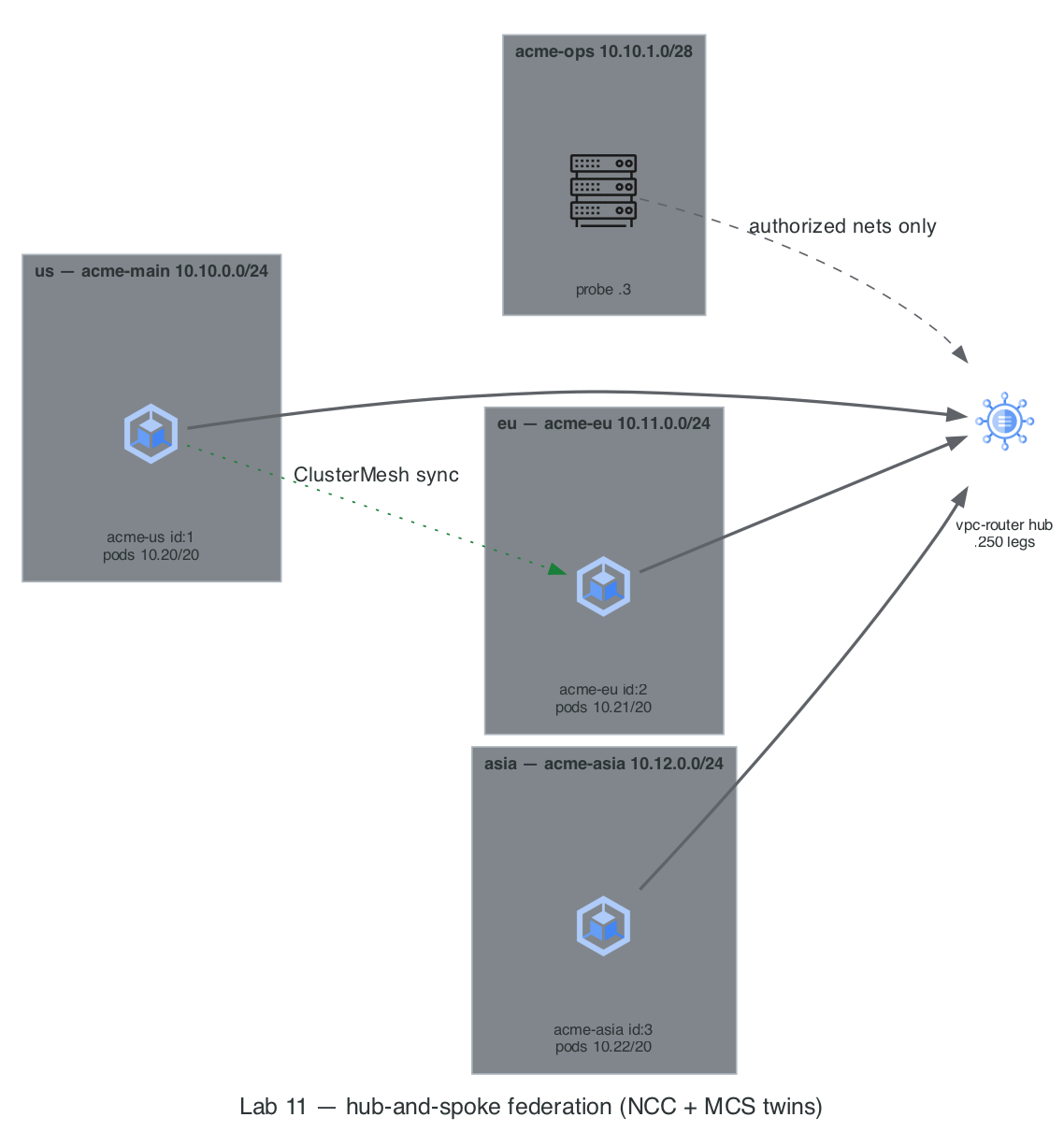
Regional IPAM (extends the Master Blueprint, Reference §00)¶
| Region | Profile | Node subnet (VPC) | Pod CIDR | Service CIDR | Cilium cluster.id |
Domain |
|---|---|---|---|---|---|---|
| us (hub) | acme |
acme-main 10.10.0.0/24 |
10.20.0.0/20 |
10.30.0.0/24 |
1 | orders |
| eu | acme-eu |
acme-eu 10.11.0.0/24 |
10.21.0.0/20 |
10.31.0.0/24 |
2 | payments |
| asia (optional) | acme-asia |
acme-asia 10.12.0.0/24 |
10.22.0.0/20 |
10.32.0.0/24 |
3 | inventory |
Architect's Observation: Every kubectl/helm/cilium command in this lab takes an explicit
--context. One kubeconfig, one context per region — the local twin ofgcloud container clusters get-credentialsper regional cluster. Never run a barekubectlin a federation; "which cluster am I pointing at?" is the #1 multi-cluster incident.
Prerequisite: the Cilium CLI for mesh operations:
brew install cilium-cli        # macOS
kubectl --context acme get nodes   # expect 3 Ready — the us hub must be healthy first
3. Step-by-Step Hands-On Build¶
Step 1: Stamp the eu Region¶
acme-k8s-lab/region-up.sh is the Lab 02 bootstrap parameterized by region — the same cold-rebuild muscle from Lab 10, now used as a regional cluster factory:
task lab11:region   # = ./acme-k8s-lab/region-up.sh eu 11 2 2
                    #   (REGION=eu OCTET=11 NODES=2 ID=2 are the task defaults)
Walk through what it did — each block twins a Terraform/NCC step:
docker network create acme-eu→ regional VPC subnet (google_compute_subnetworkineurope-west1)docker network connect --ip 10.11.0.250 acme-eu vpc-router→ NCC spoke attachmentminikube start -p acme-eu --network=acme-eu --static-ip=10.11.0.10 …→ regional GKE clusterip route replace 10.8.0.0/13 via 10.11.0.250on eu nodes + reciprocalvia 10.10.0.250onacme-maincontainers → spoke routes through the hub (one/13covers everyacme-*subnet, present and future)iptables FORWARDpair rules region↔us onvpc-router→ NCC + firewall policy;acme-opsdeliberately excluded so each region still needs its own "authorized networks" punch-through- Cilium via Helm with
cluster.name=acme-eu cluster.id=2→ ADVANCED_DATAPATH + a fleet-unique identity
kubectl --context acme-eu get nodes -o wide    # acme-eu + acme-eu-m02, Ready
kubectl --context acme-eu get pods -n kube-system -o wide | grep cilium
Step 2: Give the us Cluster a Fleet Identity¶
The hub cluster was installed before it had siblings — retrofit the ClusterMesh identity (unique name + id) without touching the rest of the Helm values:
task lab11:us-id   # helm --reuse-values: cluster.name=acme-us cluster.id=1 + restart

kubectl --context acme    exec -n kube-system ds/cilium -- cilium status --brief
kubectl --context acme-eu exec -n kube-system ds/cilium -- cilium status --brief
Architect's Observation:
cluster.idis Cilium's equivalent of a GCP fleet membership ID — it is how remote clusters distinguish whose10.21.xendpoints are whose. Two clusters with the same id/name cannot mesh.
Step 3: Mesh the Two Clusters¶
task lab11:mesh   # clustermesh enable (NodePort) on both contexts + connect us->eu
                  # + waits + status on each side
Expected: each side reports the remote cluster ready. Behind the scenes, the us agents dialed 10.11.0.x:<NodePort> through vpc-router — if your spoke routes or FORWARD pair rules were wrong, this is where it fails first (→ Drill 1).
Step 4: Deploy the Domain Workloads¶
payments is deployed in both regions with the same name+namespace and the global annotation — that is what merges its endpoints into one fleet-wide service (MCS ServiceExport twin). orders lives only in us; it is the caller.
# us region: orders (caller) + a local payments replica (fallback)
kubectl --context acme create namespace orders
kubectl --context acme -n orders create deployment orders --image=nginxdemos/hello --replicas=2
kubectl --context acme -n orders expose deployment orders --port=80

kubectl --context acme create namespace payments
kubectl --context acme -n payments create deployment payments --image=nginxdemos/hello --replicas=1
kubectl --context acme -n payments expose deployment payments --port=80
kubectl --context acme -n payments annotate svc payments service.cilium.io/global=true

# eu region: payments (the domain owner)
kubectl --context acme-eu create namespace payments
kubectl --context acme-eu -n payments create deployment payments --image=nginxdemos/hello --replicas=2
kubectl --context acme-eu -n payments expose deployment payments --port=80
kubectl --context acme-eu -n payments annotate svc payments service.cilium.io/global=true
Step 5: Prove the Federation with Evidence¶
# 1. The merged service: LOCAL (10.20.x) + REMOTE (10.21.x) backends side by side
kubectl --context acme -n payments get endpoints payments

# 2. Call it from the orders domain — plain service name, no DNS tricks
kubectl --context acme -n orders run caller --image=nicolaka/netshoot -- sleep 3600
kubectl --context acme -n orders exec caller -- sh -c \
  'for i in 1 2 3 4; do curl -sm3 http://payments.payments | grep -i "server name"; done'

# 3. Watch the traffic: which flows left the region?
kubectl --context acme    exec -n kube-system ds/cilium -- hubble observe --namespace payments --last 10
kubectl --context acme-eu exec -n kube-system ds/cilium -- hubble observe --namespace payments --last 10

# 4. Underlay proof: how does a us node reach the eu node subnet?
docker exec acme ip route get 10.11.0.10     # expect: via 10.10.0.250 (vpc-router)
Architect's Observation: Nothing here used
kubectl port-forward,/etc/hosts, or a shared node network. Cross-cluster pod traffic is VXLAN between node IPs (10.10.x↔10.11.x) routed through the hub — exactly how VPC-native GKE pod IPs flow across NCC spokes.
Step 6: Per-Region Master Authorized Networks (Repeat of the Lab 02 Drill)¶
region-up.sh left acme-ops→eu denied. Authorize it explicitly — on GCP this is per-cluster master_authorized_networks_config, not a fleet-wide default:
docker exec probe curl -sk -m 3 -o /dev/null -w '%{http_code}\n' https://10.11.0.10:8443/version || true
# Predict: 000 — FORWARD DROP on vpc-router (ops is not a trusted spoke)

docker exec vpc-router iptables -A FORWARD -s 10.10.1.3 -d 10.11.0.10 -p tcp --dport 8443 -j ACCEPT
docker exec probe curl -sk https://10.11.0.10:8443/version
4. Deliberate Break & Triage Drills¶
Drill 1: Sever the Spoke (NCC Route/Firewall Failure)¶
# Kill only the us->eu direction at the hub
docker exec vpc-router iptables -D FORWARD -s 10.10.0.0/24 -d 10.11.0.0/24 -j ACCEPT

# Predict first, then observe:
cilium clustermesh status --context acme       # remote cluster flips not-ready
kubectl --context acme -n payments get endpoints payments   # remote 10.21.x backends drained
kubectl --context acme -n orders exec caller -- curl -sm3 http://payments.payments | grep -i "server name"

# Restore the spoke
docker exec vpc-router iptables -A FORWARD -s 10.10.0.0/24 -d 10.11.0.0/24 -j ACCEPT
Signature: ClusterMesh marks the remote cluster unreachable within seconds and drains its endpoints from every global service — the mesh degrades gracefully to local-only backends instead of blackholing. This is the failure mode MCS replicates on GCP when a spoke disconnects.
Drill 2: Regional Outage (DR Failover)¶
minikube stop -p acme-eu
kubectl --context acme -n orders exec caller -- curl -sm3 http://payments.payments | grep -i "server name"
# Expected: still 200 — served by the us-local payments replica

minikube start -p acme-eu
# REMEMBER (Lab 01): docker-exec'd routes die with the container netns — re-run the
# routes block from region-up.sh (or re-run the script; every step is idempotent).
Drill 3: Predict the Overlap Trap (No Commands — Reason It Out)¶
You add asia but fat-finger the bootstrap: pod-network-cidr=10.20.0.0/20 (same as us). Both clusters come up healthy in isolation. What breaks the moment ClusterMesh connects? (Answer in the Readiness Gate.)
5. Readiness Gate G-11¶
Verify you can answer from memory:
- Why must pod CIDRs be unique before ClusterMesh/NCC peering, and what is the exact failure when they overlap? (Both clusters allocate the same
10.20.xpod IPs; remote endpoints are indistinguishable from local ones — packets for a "remote" pod route to a same-IP local pod or vanish. Isolation hides it; connectivity exposes it.) - What does
service.cilium.io/global=truetwin on GCP, and where do remote endpoints actually live? (MCSServiceExport: endpoints from every fleet cluster with a same-name/namespace service are propagated into each member's service — the local10.20.xand remote10.21.xbackends you saw inkubectl get endpoints.) - When is ADR-01 Option B (N clusters) justified over Option A (1 cluster + namespaces/node pools)? (Regulatory hard boundaries like PCI CDE, independent upgrade cadence per team, or genuine regional presence. Otherwise Option A wins on cost and east-west latency.)
- Why does eu→asia traffic traverse
vpc-routerinstead of going direct? (Hub-and-spoke: transitivity is an explicit FORWARD + route decision at the hub — the twin of NCC, where spoke-to-spoke connectivity flows through the hub routing config, not through implicit VPC peering.)
6. Your Turn: The Third Region¶
task lab11:region REGION=asia OCTET=12 ID=3
task lab11:mesh   REGION=asia
# deploy inventory in acme-asia, annotate global, re-run Step 5
Note what you did not have to edit: the IPAM table already reserved asia's ranges, 10.8.0.0/13 already routes it, and region-up.sh pairs its FORWARD rules with every existing acme-* 10.x network. Federation should feel boring — that's the proof the architecture was right.
Previous: Lab 10 · Cold Rebuild & GKE Handoff · Reference: ADR-01 & Master IPAM