Bundle Walkthrough — Line by Line
This page reads the real files in examples/labs-proxy/ one line at a
time. Hover (or tap) the numbered + markers in each code block — each one
explains the line it sits on. Come back here whenever a lab references a
file and you want the full context.
Learning approach
Predict, then reveal. Before you open any annotation, guess what the line does. The gap between your guess and the explanation is where the learning happens.
The map
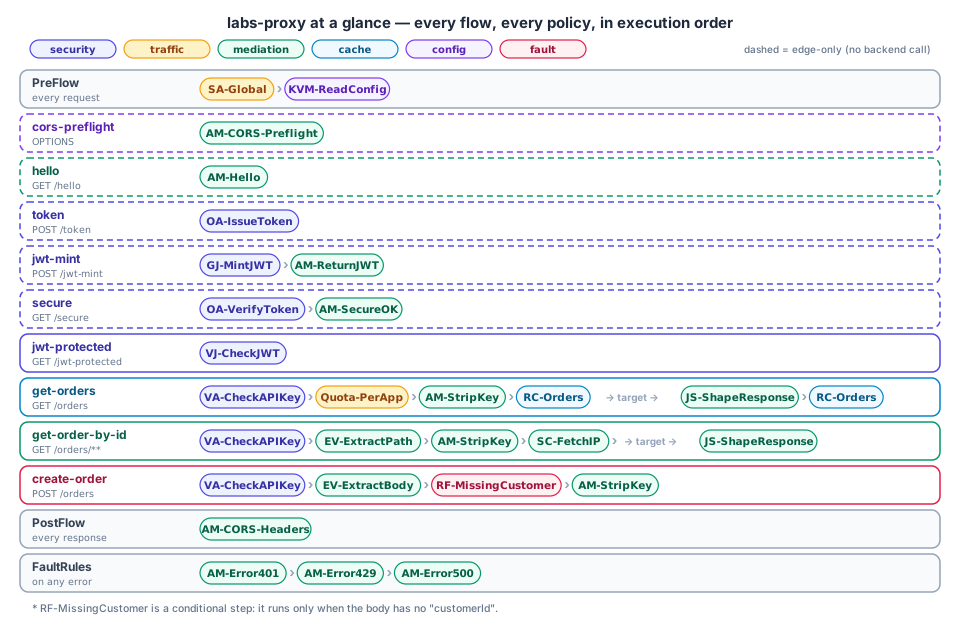
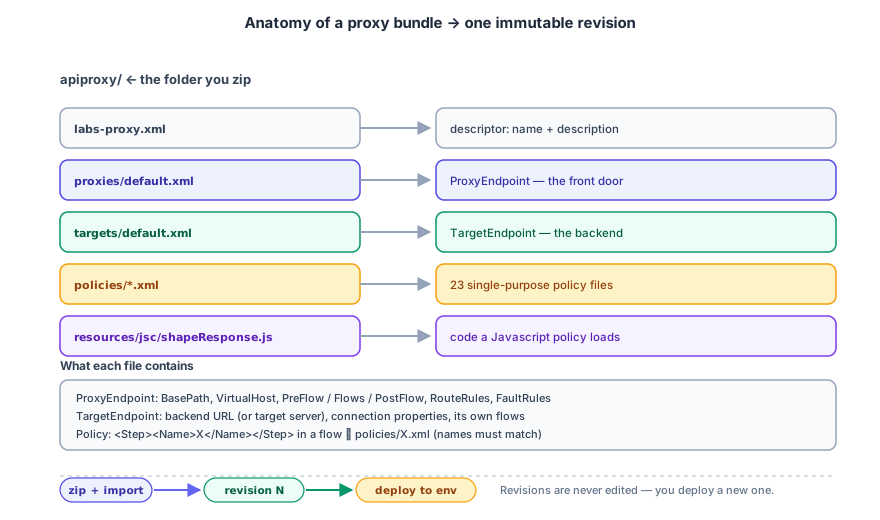
1. labs-proxy.xml — the descriptor
<?xml version="1.0" encoding="UTF-8" standalone="yes"?> <!-- (1)! -->
<APIProxy name="labs-proxy"> <!-- (2)! -->
  <Description>Hands-on labs proxy — see docs/apigee/ for the guided labs</Description> <!-- (3)! -->
</APIProxy>
- Standard XML prolog. Every Apigee config file starts this way.
nameis the proxy's identity in the org. It is what you pass toapigeecli ... -n labs-proxyand what products list under--proxies. Changing it creates a different proxy, not a new revision.- Free text shown in the console. Note this file does not list endpoints or policies — Apigee discovers those from the folders.
2. proxies/default.xml — the front door
The file is long, so it's split into the five regions you'll find in any ProxyEndpoint: PreFlow, conditional Flows, PostFlow, fault handling, and connection + routing.
2a. PreFlow — runs for every request
<ProxyEndpoint name="default"> <!-- (1)! -->
  <PreFlow name="PreFlow"> <!-- (2)! -->
    <Request> <!-- (3)! -->
      <Step><Name>SA-Global</Name></Step> <!-- (4)! -->
      <Step><Name>KVM-ReadConfig</Name></Step> <!-- (5)! -->
    </Request>
    <Response/> <!-- (6)! -->
  </PreFlow>
- The endpoint's own name. A proxy may have several ProxyEndpoints (e.g.
different base paths);
defaultis the conventional single one. - PreFlow is the mandatory first stop: no conditions, no skipping. Put things here that must hold for every call — rate limiting, config loading, authentication that covers the whole API.
<Request>= the inbound half of this phase (client → proxy).- Spike arrest first. It's the cheapest check and protects everything after it. A flood is rejected before any key lookup, KVM read or backend call is paid for.
- Loads
cors.origin,jwt.secretandcache.ttlinto flow variables. It has to run before any step that uses{kvm.cors.origin}orprivate.jwt.secret— which is why it lives in PreFlow, not in each flow. - Empty
<Response/>— nothing to do on the way back out at this phase. The element is still written so the structure is explicit.
2b. Conditional flows — "one of these"
  <Flows>
    <Flow name="cors-preflight"> <!-- (1)! -->
      <Condition>(request.verb = "OPTIONS")</Condition> <!-- (2)! -->
      <Request>
        <Step><Name>AM-CORS-Preflight</Name></Step> <!-- (3)! -->
      </Request>
      <Response/>
    </Flow>

    <Flow name="hello">
      <Condition>(proxy.pathsuffix MatchesPath "/hello") and (request.verb = "GET")</Condition> <!-- (4)! -->
      <Request/>
      <Response>
        <Step><Name>AM-Hello</Name></Step> <!-- (5)! -->
      </Response>
    </Flow>
- Flows are evaluated top to bottom; the first whose condition is true
wins and the rest are skipped. So the order in this file is part of the
behaviour.
cors-preflightis first on purpose: a browser preflight to any path should be answered before path-specific flows are considered. - Matches on verb only — any path. Parentheses are optional here but
keep conditions readable when you add
and/orlater. - Builds the
204response with CORS headers. Because the next section's RouteRule sendsOPTIONSto no target (edge-only), this is the response; the backend never hears about the preflight. - Both halves must be true: path suffix is exactly
/hello(after the/labsbase path) and it's aGET. APOST /hellomatches no flow here and falls through to the target — that's Lab 1's experiment 2. - The step is in
<Response>even though no backend is called: for edge-only routes the response phase is still where the reply is shaped.AM-Hellosets the response body and status.
    <Flow name="token">
      <Condition>(proxy.pathsuffix MatchesPath "/token") and (request.verb = "POST")</Condition>
      <Request>
        <Step><Name>OA-IssueToken</Name></Step> <!-- (1)! -->
      </Request>
      <Response/>
    </Flow>

    <Flow name="jwt-mint">
      <Condition>(proxy.pathsuffix MatchesPath "/jwt-mint") and (request.verb = "POST")</Condition>
      <Request>
        <Step><Name>GJ-MintJWT</Name></Step> <!-- (2)! -->
        <Step><Name>AM-ReturnJWT</Name></Step> <!-- (3)! -->
      </Request>
      <Response/>
    </Flow>

    <Flow name="jwt-protected">
      <Condition>(proxy.pathsuffix MatchesPath "/jwt-protected") and (request.verb = "GET")</Condition>
      <Request>
        <Step><Name>VJ-CheckJWT</Name></Step> <!-- (4)! -->
      </Request>
      <Response/>
    </Flow>

    <Flow name="secure">
      <Condition>(proxy.pathsuffix MatchesPath "/secure") and (request.verb = "GET")</Condition>
      <Request>
        <Step><Name>OA-VerifyToken</Name></Step> <!-- (5)! -->
        <Step><Name>AM-SecureOK</Name></Step> <!-- (6)! -->
      </Request>
      <Response/>
    </Flow>
OAuthV2withGenerateAccessTokenwrites the HTTP response itself (<GenerateResponse enabled="true"/>), which is why this flow needs no second step.- Signs a JWT and stores it in the variable
generated_jwt. Nothing is returned to the client yet — it's just a variable. - Wraps that variable into
{"token": "..."}. Splitting create and return keeps each policy single-purpose. - Verifies the incoming JWT and then lets the request continue to the backend (this path is not in the edge-only RouteRule, so it routes to the target). If verification fails, the flow aborts into FaultRules and the backend is never contacted.
- Fails with
InvalidAccessToken/access_token_expiredetc. if the bearer token is bad; otherwise setsdeveloper.app.nameand friends. - Reads
{developer.app.name}— only available because step 5 succeeded. Order = dependency order.
    <Flow name="get-orders">
      <Condition>(proxy.pathsuffix MatchesPath "/orders") and (request.verb = "GET")</Condition>
      <Request>
        <Step><Name>VA-CheckAPIKey</Name></Step> <!-- (1)! -->
        <Step><Name>Quota-PerApp</Name></Step> <!-- (2)! -->
        <Step><Name>AM-StripKey</Name></Step> <!-- (3)! -->
        <Step><Name>RC-Orders</Name></Step> <!-- (4)! -->
      </Request>
      <Response>
        <Step><Name>JS-ShapeResponse</Name></Step> <!-- (5)! -->
        <Step><Name>RC-Orders</Name></Step> <!-- (6)! -->
      </Response>
    </Flow>
- Authenticate → produces
client_id, developer, app, product. - Count → needs
client_idfrom step 1 for itsIdentifier. - Sanitize → remove the
apikeyquery param before anything leaves the proxy. It's after Quota because Quota only needs the variable, not the raw query param. - Cache lookup. It comes after auth and quota on purpose: an
unauthenticated caller can never read a cached response, and cache hits
still count against the quota. If you want hits to be "free", move this
step above
Quota-PerApp— and think hard about who can then read cached data. - Runs in the response phase for both misses and hits. It wraps the body and stamps quota/app info. (It has an explicit branch for hits — see the JS walkthrough.)
- Same policy, second attachment — now in
<Response>it populates the cache. A hit skips the target and, because the policy's response-side attachment is skipped on a hit, nothing is re-stored.
    <Flow name="get-order-by-id">
      <Condition>(proxy.pathsuffix MatchesPath "/orders/**") and (request.verb = "GET")</Condition> <!-- (1)! -->
      <Request>
        <Step><Name>VA-CheckAPIKey</Name></Step>
        <Step><Name>EV-ExtractPath</Name></Step> <!-- (2)! -->
        <Step><Name>AM-StripKey</Name></Step>
        <Step><Name>SC-FetchIP</Name></Step> <!-- (3)! -->
      </Request>
      <Response>
        <Step><Name>JS-ShapeResponse</Name></Step>
      </Response>
    </Flow>

    <Flow name="create-order">
      <Condition>(proxy.pathsuffix MatchesPath "/orders") and (request.verb = "POST")</Condition> <!-- (4)! -->
      <Request>
        <Step><Name>VA-CheckAPIKey</Name></Step>
        <Step><Name>EV-ExtractBody</Name></Step> <!-- (5)! -->
        <Step>
          <Condition>!(request.content ~~ "(?s).*customerId.*")</Condition> <!-- (6)! -->
          <Name>RF-MissingCustomer</Name>
        </Step>
        <Step><Name>AM-StripKey</Name></Step>
      </Request>
      <Response/>
    </Flow>
  </Flows>
/**= any depth below/orders/./orders/42and/orders/42/itemsboth match; plain/ordersdoes not (it belongs toget-orders).- Pulls
42intourirequest.orderId. - A blocking side request to
httpbin.org/ip. The result lands inipResponse.content, whichJS-ShapeResponsereads asenrichedFrom. Note there's no caching here — every call pays the callout latency. - Same path as
get-ordersbut a different verb; both conditions must be true, so the two flows never collide. - Extracts
$.customerIdintoextracted.customerId. WithIgnoreUnresolvedVariables=truea missing field is not an error — which is exactly why the next step validates explicitly. - A conditional step: this single step runs only if the body doesn't
contain
customerId.~~is the Java-regex operator and(?s)lets.match newlines so multi-line JSON still works. When it runs,RF-MissingCustomerraises a 400 and the flow stops.
2c. PostFlow, faults, connection, routing
  <PostFlow name="PostFlow">
    <Request/>
    <Response>
      <Step><Name>AM-CORS-Headers</Name></Step> <!-- (1)! -->
    </Response>
  </PostFlow>

  <FaultRules> <!-- (2)! -->
    <FaultRule name="auth-faults">
      <Step><Name>AM-Error401</Name></Step>
      <Condition>(fault.name = "FailedToResolveAPIKey") or
                (fault.name = "InvalidApiKey") or
                (fault.name = "InvalidAccessToken") or
                (fault.name Matches "*Token*") or
                (fault.name Matches "*Signature*") or
                (fault.name Matches "*JWT*")</Condition> <!-- (3)! -->
    </FaultRule>
    <FaultRule name="throttled">
      <Step><Name>AM-Error429</Name></Step>
      <Condition>(fault.name = "QuotaViolation") or
                (fault.name = "SpikeArrestViolation")</Condition> <!-- (4)! -->
    </FaultRule>
  </FaultRules>
  <DefaultFaultRule name="fallback">
    <Step><Name>AM-Error500</Name></Step> <!-- (5)! -->
    <Condition>fault.name != "RaiseFault"</Condition> <!-- (6)! -->
  </DefaultFaultRule>
- PostFlow runs last in the proxy's response phase, for every successful call — the right home for headers every response needs.
- Only evaluated when something faulted. Rules are checked top to bottom and the first matching one runs.
- Matches on
fault.name. Several spellings are listed because the names differ by policy (FailedToResolveAPIKeyfrom VerifyAPIKey,InvalidAccessTokenfrom OAuthV2,TokenExpired/InvalidSignaturefrom VerifyJWT). The wildcard lines catch variants you didn't enumerate. - Both traffic policies map to the same client-facing story: slow down and retry — HTTP 429.
- The catch-all keeps clients from ever seeing Apigee's default fault format. It runs only if no FaultRule above it executed.
- Exclusion for deliberate faults:
RF-MissingCustomeris aRaiseFaultthat already builds a precise400. Without this condition the catch-all would run afterwards and overwrite that 400 with a generic 500.
Why not AlwaysEnforce?
<AlwaysEnforce>true</AlwaysEnforce> makes the default rule run even
when a FaultRule already handled the error. With an unconditional
AM-Error500 that means every 401 and 429 would be overwritten with a
500. Leave it off unless the default rule is meant to add something
(e.g. a logging step) to every error.
  <HTTPProxyConnection>
    <BasePath>/labs</BasePath> <!-- (1)! -->
    <VirtualHost>default</VirtualHost> <!-- (2)! -->
  </HTTPProxyConnection>

  <RouteRule name="edge-only"> <!-- (3)! -->
    <Condition>(request.verb = "OPTIONS") or
               (proxy.pathsuffix MatchesPath "/hello") or
               (proxy.pathsuffix MatchesPath "/token") or
               (proxy.pathsuffix MatchesPath "/jwt-mint") or
               (proxy.pathsuffix MatchesPath "/secure")</Condition>
  </RouteRule>
  <RouteRule name="default"> <!-- (4)! -->
    <TargetEndpoint>default</TargetEndpoint>
  </RouteRule>
</ProxyEndpoint>
- Every URL for this proxy begins with
/labs. What follows isproxy.pathsuffix. Two proxies in one environment group can't share a base path. - In Apigee X the virtual host is effectively the environment group; the value is a legacy name kept for compatibility.
- A RouteRule with no
<TargetEndpoint>means "no backend" — Apigee skips the target entirely and builds the response from the proxy side. This is the mechanism behind every dashed row in the map above. - The unconditional rule must be last: rules are evaluated in order, so an unconditioned rule placed first would swallow every request.
3. targets/default.xml — the backend
<TargetEndpoint name="default"> <!-- (1)! -->
  <HTTPTargetConnection>
    <URL>https://mocktarget.apigee.net</URL> <!-- (2)! -->
    <Properties>
      <Property name="success.codes">2xx</Property> <!-- (3)! -->
    </Properties>
  </HTTPTargetConnection>
</TargetEndpoint>
- The name referenced by
<RouteRule><TargetEndpoint>default</...>. - Where the request is forwarded. The path suffix and query string are
appended automatically:
/labs/orders?x=1→/orders?x=1. (For per-env hosts use aLoadBalancer/target server — see Deploy & CI/CD.) - Narrows "success" to 2xx. By default Apigee treats 1xx–3xx as success and
4xx/5xx as failures that enter fault handling; with this property a 3xx
from the backend is a failure too. Set it deliberately — e.g.
2xx,3xxif your backend redirects.
4. shapeResponse.js — the JavaScript
var ctx = context; // (1)!

var cacheHit = ctx.getVariable("responsecache.RC-Orders.cachehit"); // (2)!
var app      = ctx.getVariable("developer.app.name") || "anonymous"; // (3)!
var dev      = ctx.getVariable("developer.email") || "n/a";
var orderId  = ctx.getVariable("urirequest.orderId") || null; // (4)!

var origin = null;
try {
  origin = JSON.parse(ctx.getVariable("ipResponse.content") || "{}").origin || null; // (5)!
} catch (e) {}

var upstream = {};
try {
  upstream = JSON.parse(ctx.getVariable("response.content") || "{}"); // (6)!
} catch (e) {
  upstream = { raw: ctx.getVariable("response.content") };
}

var body;
if (cacheHit === true || cacheHit === "true") { // (7)!
  upstream.cache = "hit (edge)";
  body = upstream;
} else {
  body = {
    message: orderId ? "order " + orderId : "orders list",
    app: app,
    developer: dev,
    orderId: orderId,
    quota: {
      allowed:   ctx.getVariable("ratelimit.Quota-PerApp.allowed.count"), // (8)!
      used:      ctx.getVariable("ratelimit.Quota-PerApp.used.count"),
      available: ctx.getVariable("ratelimit.Quota-PerApp.available.count")
    },
    enrichedFrom: origin,
    upstream: upstream,
    cache: "miss (backend)"
  };
}

ctx.setVariable("response.content", JSON.stringify(body)); // (9)!
ctx.setVariable("response.header.content-type", "application/json");
print("JS-ShapeResponse cacheHit=" + cacheHit + " orderId=" + orderId); // (10)!
contextis the global object Apigee injects into every JS policy — the bridge to flow variables. Aliasing it keeps lines short.<policy-type>.<policy-name>.<property>again: theResponseCachepolicy namedRC-Orderspublishescachehit.|| "anonymous"— flow variables you didn't set returnnull, so give every read a default. (On/ordersthese exist becauseVA-CheckAPIKeyran first.)- Only set when
EV-ExtractPathran, i.e. on/orders/{id}; elsewherenull. ipResponseis the name given inSC-FetchIP's<Response>. Thetryprotects against the callout being absent (the plain/ordersflow has no callout) or returning non-JSON.- At this point (response flow)
response.contentis the backend's body. - Cache hits arrive here with the body already shaped (it was stored after this policy ran), so we only annotate. Re-wrapping would nest the envelope inside itself on every hit. Note the two comparisons: depending on the runtime the variable can be a boolean or a string.
Quotapublishesratelimit.<policy>.allowed.count,.used.count,.available.count. (Older Apigee material showsquota.*— that is not a thing in Apigee X.)- Writing
response.contentreplaces the body the client will see. AlwaysJSON.stringify— it's a string variable. - Output appears in the Debug/Trace panel for this step. It's your only
console.log.
5. deploy.sh — the glue
set -euo pipefail # (1)!

SCRIPT_DIR="$(cd "$(dirname "$0")" && pwd)" # (2)!
: "${APIGEE_ORG:?export APIGEE_ORG first}" # (3)!
APIGEE_ENV="${APIGEE_ENV:-eval}" # (4)!
TOKEN="${TOKEN:-$(gcloud auth print-access-token)}" # (5)!

apigeecli kvms create -o "$APIGEE_ORG" -e "$APIGEE_ENV" -n labs-config -t "$TOKEN" 2>/dev/null || true # (6)!

seed() {  # create-or-update a KVM entry
  apigeecli kvms entries create ... 2>/dev/null \
  || apigeecli kvms entries update ... >/dev/null # (7)!
}

seed cors.origin "https://myspa.example.com" # (8)!
seed jwt.secret  "lab-secret-do-not-use-in-prod-0123456789" # (9)!
seed cache.ttl   "60"

apigeecli apis create bundle -o "$APIGEE_ORG" -e "$APIGEE_ENV" \
  --proxy-folder "$SCRIPT_DIR/apiproxy" -n labs-proxy -t "$TOKEN" --ovr # (10)!
- Strict mode: exit on any error (
-e), on unset variables (-u), and on failures inside pipes (pipefail). A half-deployed proxy is worse than a loud failure. - Resolve the script's own directory so it works from any working directory.
${VAR:?msg}aborts withmsgifAPIGEE_ORGis unset — fail fast with a useful message instead of a confusing API error.- Default env
eval, overridable:APIGEE_ENV=dev ./deploy.sh. - Use an exported
TOKENif present, else mint one from your gcloud login. - Create the KVM;
|| truemakes re-runs idempotent (it already exists). - "Upsert" idiom: try create, fall back to update.
- Origin allowed by CORS (Lab 7).
- The JWT HMAC key. Apigee enforces a 32-byte minimum for HS256 —
a shorter key makes
GenerateJWT/VerifyJWTfail at runtime withInsufficientKeyLength, which is why this value is longer than a typical "lab secret". - Zip the folder, import it as a new revision, and deploy it with
--ovr("override"): replaces whatever revision is currently deployed.
Check yourself
1. Reorder: Quota-PerApp, VA-CheckAPIKey, AM-StripKey. Which orders are valid and why?
VA-CheckAPIKey must precede Quota-PerApp (the identifier variable
doesn't exist before it). AM-StripKey is independent of Quota and can be
anywhere after authentication — but must be before the request leaves for
the target.
2. You add a new flow /orders/** GET above get-orders. What breaks?
Nothing for /orders (exact match doesn't hit /**), but if your new flow
used MatchesPath "/**" it would shadow everything below it. First
match wins — pattern order is behaviour.
3. Why doesn't /hello hit mocktarget even though a default RouteRule exists?
The edge-only RouteRule is listed first and its condition matches, so
it wins; it has no TargetEndpoint, so no backend call is made.
4. Predict: GET /labs/orders with a valid key, called twice in 10 s. What differs in the second response body?
cache becomes "hit (edge)", and the quota/app fields from the
first (shaped) response are the ones replayed — the quota counter is
not recomputed in the cached body, though the hit still increments
the real counter.