Core Concepts
Read this page once, slowly. Almost every "why did that happen?" in the labs traces back to one of the ideas below.
How to study this page
- Read each section's one-line takeaway first.
- Cover the answer under each Recall box and say it out loud before you open it. Retrieving an answer beats re-reading it.
- Come back after Lab 4 and re-test yourself — spacing your practice is what moves this from "I saw it" to "I know it".
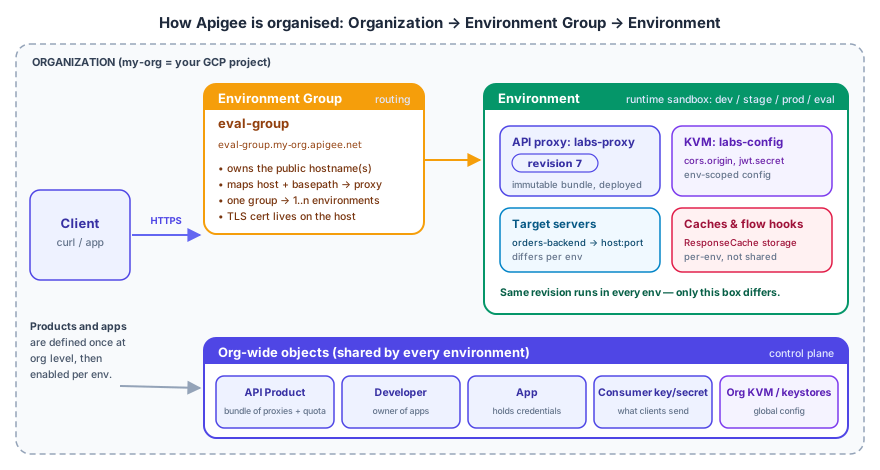
1. The big picture: who owns what
| Object | Scope | What it is | Why you care |
|---|---|---|---|
| Organization | whole account | Top-level container; in Apigee X it maps 1:1 to a GCP project | -o $APIGEE_ORG in every apigeecli call |
| Environment | org | A runtime sandbox (dev, stage, prod, eval) where revisions are deployed |
Config (KVMs, target servers) differs per env; the bundle does not |
| Environment group | org | A set of hostnames mapped to one or more environments | It's why curl https://eval-group.my-org.apigee.net/... finds your proxy |
| API proxy | org (deployed per env) | The bundle you write — a facade for a backend | The thing you build in every lab |
| Revision | per proxy | One immutable snapshot of the bundle | Deploy, roll back and promote revisions |
| API product | org | A named bundle of proxies/paths + quota + scopes | What you "sell" or grant to developers |
| Developer | org | The person/team who owns apps | Appears as developer.email in flow variables |
| App | org | Holds credentials (consumer key + secret) and is attached to products | The thing a request authenticates as |
Takeaway
Proxies are deployed per environment; products, developers and apps are defined once per organization.
Recall: your request returned Unable to identify proxy for host. Which object is wrong?
The environment group hostname (or the proxy's BasePath) — Apigee
couldn't route host + path to any deployed proxy. The proxy code is
probably fine.
2. Who is calling? Product → Developer → App → Credential
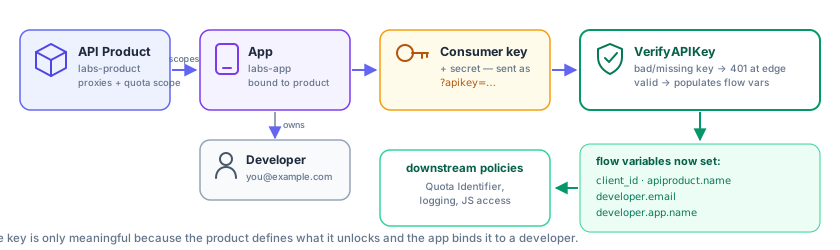
A key is just a random string. It means something only because Apigee can
walk key → app → product(s) → proxy + path + quota. That walk is what
VerifyAPIKey performs, and its results become flow variables
(developer.email, apiproduct.name, ...).
- A key can be valid yet still rejected if the app's products don't cover
the proxy/environment being called (
InvalidApiKeyForGivenResource). - Revoking an app, a key or a product takes effect on the next call — no redeploy.
Recall: name three things a valid key gives the proxy besides 'yes, it's valid'.
The developer identity (developer.email), the app (developer.app.name)
and the product (apiproduct.name) — plus the key itself in
verifyapikey.<policy>.client_id, which is what Quota uses to count per
app.
3. Anatomy of one policy file
Every policy is a small XML file with the same skeleton. Learn the skeleton once; every policy in the cookbook is a variation on it.
<AssignMessage async="false" continueOnError="false" enabled="true" name="AM-Hello"> <!-- (1)! -->
  <DisplayName>AM-Hello</DisplayName> <!-- (2)! -->
  <Set> <!-- (3)! -->
    <Payload contentType="application/json">
      {"message": "hello from apigee", "path": "{proxy.pathsuffix}"} <!-- (4)! -->
    </Payload>
    <StatusCode>200</StatusCode>
  </Set>
  <IgnoreUnresolvedVariables>true</IgnoreUnresolvedVariables> <!-- (5)! -->
  <AssignTo createNew="false" type="response">response</AssignTo> <!-- (6)! -->
</AssignMessage>
- Root element = policy type (
AssignMessage). The attributes are common to all policies:namemust equal the file name and the<Step><Name>;enabled="false"turns the policy into a no-op without deleting it;continueOnError="true"lets the flow carry on even if this policy fails (defaultfalse→ the flow jumps to fault handling);asyncis legacy — leave itfalse. - Human-readable label shown in the UI and Trace. Purely cosmetic.
- The operation block. AssignMessage can
Set,Copy,Add,RemoveorAssignVariable; other policies have their own verbs (Operation,Get,Rate, ...). {variable}inside curly braces is interpolated at runtime from the flow-variable bag. Unresolved variables become empty strings only if #5 istrue; otherwise they fail the policy.- Safety valve.
false(default for most policies) = a missing variable is a fault;true= silently substitute empty. Preferfalsewhile developing so typos surface immediately. - Which message to modify.
type="response"+createNew="false"means "edit the existing response object". WithoutAssignTo, AssignMessage edits whichever message is current at the flow position where it runs.
Takeaway
name ties file ↔ step. continueOnError/enabled control failure and
switching. {braces} read variables. AssignTo picks the message.
Recall: a policy references {kvm.cors.origin} but the KVM read was skipped. What happens with IgnoreUnresolvedVariables = false vs true?
false → the policy faults (and your FaultRules run). true → the header
is set to an empty value and the request continues silently — easier to
miss, which is why the labs only use true in error policies where a
second failure would hide the first.
4. Flow variables — the shared notebook
Every transaction gets its own variable bag. Policies write to it, conditions and later policies read from it, and nothing outlives the request.
| Family | Examples | Writable? |
|---|---|---|
request.* / response.* |
request.verb, request.header.x-apikey, request.queryparam.apikey, response.status.code, response.content |
yes (via policies/JS) |
proxy.* |
proxy.pathsuffix, proxy.basepath, proxy.name |
read-only |
target.* |
target.url, target.name |
partly |
system.* |
system.timestamp, system.uuid |
read-only |
apiproxy.* |
apiproxy.name, apiproxy.revision |
read-only |
fault.* / error.* |
fault.name, error.status.code |
only inside fault handling |
| policy-produced | verifyapikey.<name>.client_id, ratelimit.<name>.used.count, jwt.<name>.decoded.claim.sub, responsecache.<name>.cachehit |
read-only, named after the policy |
| yours | anything you AssignVariable, ExtractVariables, KVM assignTo |
yes |
Two naming rules explain most surprises:
- Policy-produced variables embed the policy's
name. RenameQuota-PerAppandratelimit.Quota-PerApp.used.countbecomesratelimit.<NewName>.used.count— anything referencing the old name now resolves to nothing. - Variables prefixed
private.are masked in Trace and are required for signing keys (that's why the labs write the JWT secret toprivate.jwt.secret).
Recall: where does urirequest.orderId come from, and why that exact name?
From EV-ExtractPath. For URIPath patterns, ExtractVariables names the
variable urirequest.<placeholder> (no VariablePrefix set), so
/orders/{orderId} yields urirequest.orderId. Set <VariablePrefix> and
it becomes <prefix>.orderId instead — which is exactly what
EV-ExtractBody does with extracted.
5. Conditions — the if of Apigee
Conditions appear on <Flow>, <Step>, <RouteRule> and <FaultRule>.
| Operator | Meaning | Example |
|---|---|---|
=, != |
equals / not equals (case-sensitive) | request.verb = "GET" |
Matches / ~ |
glob-ish: * wildcard |
fault.name Matches "*Token*" |
MatchesPath / ~/ |
path glob: * = one segment, ** = any depth |
proxy.pathsuffix MatchesPath "/orders/**" |
JavaRegex / ~~ |
full Java regex | request.content ~~ "(?s).*customerId.*" |
Equals, StartsWith, Includes... |
text/collection helpers | request.header.accept Includes "json" |
Exists |
variable is set | request.header.x-no-cache Exists |
and, or, !, ( ) |
boolean logic | (a) and !(b) |
<, <=, >, >= |
numeric compare | response.status.code >= 500 |
Path-matching cheat sheet (what MatchesPath accepts):
| Pattern | /orders |
/orders/42 |
/orders/42/items |
|---|---|---|---|
"/orders" |
yes | no | no |
"/orders/*" |
no | yes | no |
"/orders/**" |
no | yes | yes |
"/**" |
yes | yes | yes |
Case and quoting traps
=is case-sensitive:request.verb = "get"never matches.- A condition on an unset variable doesn't raise an error — comparisons
like
=simply come out false (and!=comes out true), so the flow silently takes a different branch. Check spelling in Trace. - In XML, escape
<,>,&inside conditions (<,>,&).
Recall: why does the labs get-orders flow not also fire for /orders/42?
Its condition uses MatchesPath "/orders" — an exact path. The separate
get-order-by-id flow uses "/orders/**". Because flows are evaluated top
to bottom and the first match wins, ordering also matters when
patterns overlap.
6. The request lifecycle in one picture
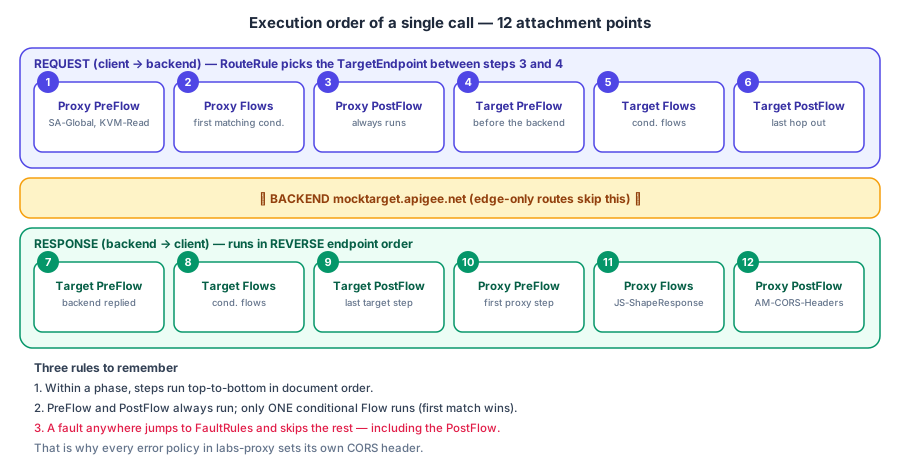
Memorize the shape: in through the proxy, in through the target, out through the target, out through the proxy. Detailed attachment rules live in Proxy Anatomy.
7. Errors in one paragraph
When any policy fails (and continueOnError is false), Apigee stops the
normal flow, sets fault.name, and evaluates the endpoint's <FaultRules>
top to bottom — first matching rule wins. If none match,
<DefaultFaultRule> runs. Normal PostFlows are skipped, so anything you
need on every response (like CORS headers) must also be added in the error
policies. Lab 6 makes this concrete.
8. Immutable revisions and environment-specific config
A deployed revision never changes. What can change without redeploying: KVM values, target servers, product quotas, app credentials. What can't: anything in the bundle. Rule of thumb: if it differs between dev and prod, it must not live in the bundle. See Deploy & CI/CD.
Self-test: the whole page in six questions
1. Which object do you rename if you want a different public hostname?
The environment group (its hostname list). Proxies and environments don't own hostnames.
2. You add <Step><Name>VA-Check</Name></Step> and get Could not find policy. Likely cause?
No policies/VA-Check.xml — or the file's name attribute differs from the
step name. The three names must match exactly.
3. Quota returns 429 on the very first call. First suspect?
The Identifier variable is empty (e.g. quota ran before VerifyAPIKey),
so all callers share one bucket. See Lab 4.
4. Where would you put a value that must differ between stage and prod?
In an environment-scoped KVM (secrets: encrypted KVM) or a target server — never in the bundle.
5. A policy faults. Does the PostFlow still run?
No — fault handling replaces the normal flow. Handle response decoration in the fault policies too.
6. request.verb = "get" never matches. Why?
Conditions are case-sensitive; the verb is uppercase ("GET").