Lab 3 — OAuth & JWT
Goal: issue OAuth access tokens with OAuthV2 and verify signed JWTs
with VerifyJWT — real authentication schemes, enforced at the edge.
~25 min.
What you'll learn
OAuthV2as token issuer (GenerateAccessToken) and verifier (VerifyAccessToken)GenerateJWT/VerifyJWTfor self-contained tokens- When opaque tokens vs. JWTs are the right tool
Part A — Client credentials flow
The bundle exposes /labs/token, handled entirely at the edge — no backend
involved:
<Flow name="token">
  <Condition>(proxy.pathsuffix MatchesPath "/token") and (request.verb = "POST")</Condition>
  <Request>
    <Step><Name>OA-IssueToken</Name></Step>
  </Request>
  <Response/>
</Flow>
<OAuthV2 name="OA-IssueToken">
  <Operation>GenerateAccessToken</Operation>
  <GrantType>client_credentials</GrantType>
  <ExpiresIn>3600000</ExpiresIn>   <!-- 1 hour, ms -->
  <SupportedGrantTypes>
    <GrantType>client_credentials</GrantType>
  </SupportedGrantTypes>
</OAuthV2>
OAuthV2 reads client_id/client_secret from the request — the same
pair from Lab 2's app.
Get a token
export CLIENT_ID=$APIKEY                      # consumer key
export CLIENT_SECRET=<consumerSecret>         # from apigeecli apps create

curl -s -X POST "https://$APIGEE_HOST/labs/token" \
  -d "grant_type=client_credentials&client_id=$CLIENT_ID&client_secret=$CLIENT_SECRET" | jq
{
  "issued_at": "1731456789000",
  "application_name": "labs-app",
  "scope": "",
  "status": "approved",
  "api_product_list": "[labs-product]",
  "expires_in": "3599",
  "developer.email": "you@example.com",
  "access_token": "AbCdEf...",
  "token_type": "BearerToken"
}
Verify it
<OAuthV2 name="OA-VerifyToken">
  <Operation>VerifyAccessToken</Operation>
</OAuthV2>
The bundle's secure flow uses this instead of VerifyAPIKey:
export TOKEN_OA=$(curl -s -X POST "https://$APIGEE_HOST/labs/token" \
  -d "grant_type=client_credentials&client_id=$CLIENT_ID&client_secret=$CLIENT_SECRET" | jq -r .access_token)

curl -i "https://$APIGEE_HOST/labs/secure" -H "Authorization: Bearer $TOKEN_OA"
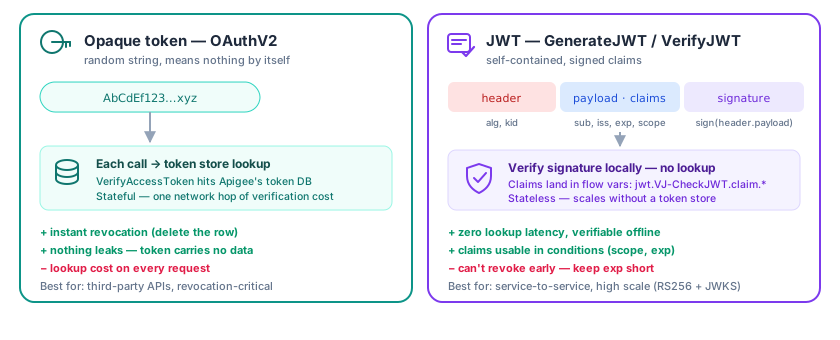
Invalid/expired token → 401 with InvalidAccessToken. Because the token is
opaque, Apigee looks it up in its token store on every call — stateful
verification, instant revocation.
Part B — JWT
JWTs flip the tradeoff: self-contained, verified with a signature — no
lookup. For the lab we issue JWTs with GenerateJWT (HS256) so you can mint
and verify without standing up an IdP:
<GenerateJWT name="GJ-MintJWT">
  <Algorithm>HS256</Algorithm>
  <SecretKey>
    <Value ref="kvm.jwt.secret"/>
  </SecretKey>
  <ExpiresIn>10m</ExpiresIn>
  <Issuer>labs-proxy</Issuer>
  <Subject ref="developer.email"/>
  <OutputVariable>generated_jwt</OutputVariable>
</GenerateJWT>
The shared secret comes from a KVM (Lab 7 covers KVMs in detail). Seed it:
apigeecli kvms create -o "$APIGEE_ORG" -e "$APIGEE_ENV" -t "$TOKEN" -n labs-config
apigeecli kvms entries create -o "$APIGEE_ORG" -e "$APIGEE_ENV" -t "$TOKEN" \
  -m labs-config -k jwt.secret -v "lab-secret-do-not-use-in-prod"
Verify the JWT
<VerifyJWT name="VJ-CheckJWT">
  <Algorithm>HS256</Algorithm>
  <Source>request.header.authorization</Source>
  <SecretKey>
    <Value ref="kvm.jwt.secret"/>
  </SecretKey>
</VerifyJWT>
# mint one via the bundle's /jwt-mint flow (POST), then:
curl -i "https://$APIGEE_HOST/labs/jwt-protected" \
  -H "Authorization: Bearer $JWT"
In Trace, expand VJ-CheckJWT: jwt.VJ-CheckJWT.decoded.claim.sub,
.iss, .exp are all populated — use them in conditions
(<Condition>jwt.VJ-CheckJWT.claim.scope Includes "orders:read"</Condition>).
HS256 is a lab convenience
Shared-secret JWTs mean the proxy and every verifier hold the same key.
Real deployments use RS256/ES256 with a public JWKS — VerifyJWT supports
<PublicKey><JWKS ref="..."/></PublicKey> so key rotation is free.
Experiments
- Expire the JWT (
ExpiresIn→10s), wait, re-verify →jwt.JWT.TokenExpired. Match it with a FaultRule that returns a clean 401. - Tamper with one character of the JWT signature →
InvalidSignature. - Compare Trace timings:
OA-VerifyToken(store lookup) vsVJ-CheckJWT(signature only). At scale this is the JWT argument. - Decode the JWT payload at jwt.io (paste is safe — it's a
lab token) and match claims to the
GenerateJWTXML.
Next
Lab 4 — Traffic Management: make sure one noisy client can't take down everyone else.