Lab 4 — Traffic Management
Goal: add SpikeArrest and Quota, then watch them fire with a small
load loop. ~20 min.
What you'll learn
- SpikeArrest ≠ Quota — burst smoothing vs. allowance
- Per-app quota using
VerifyAPIKey'sclient_ididentifier - Reading quota counters from flow variables
The distinction that trips everyone up
| Policy | Question it answers | Window | Identifier |
|---|---|---|---|
SpikeArrest |
"Is traffic arriving faster than X/sec?" | Rolling, sub-second smoothing | global (per message processor) |
Quota |
"Has this app exceeded N calls per hour?" | Fixed window (min/hour/day/week/month) | per Identifier (e.g. client_id) |
SpikeArrest protects the backend; Quota enforces the business contract.
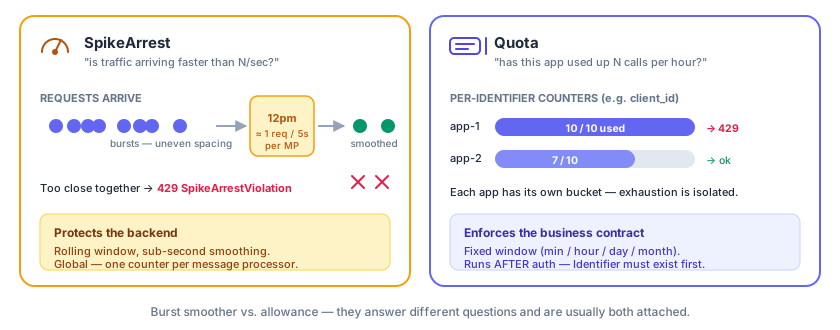
The policies
<SpikeArrest name="SA-Global">
  <Rate>12pm</Rate>   <!-- 12 per minute ≈ one request per 5 seconds -->
  <UseEffectiveCount>true</UseEffectiveCount>
</SpikeArrest>
Runs in the PreFlow — it applies to every request, including /hello.
<Quota name="Quota-PerApp">
  <Allow count="10"/>
  <Interval>1</Interval>
  <TimeUnit>minute</TimeUnit>
  <Identifier ref="verifyapikey.VA-CheckAPIKey.client_id"/>
  <Distributed>true</Distributed>
  <Synchronous>true</Synchronous>
</Quota>
Runs only in the get-orders flow, after VA-CheckAPIKey — the
Identifier variable doesn't exist until the key is validated. Order matters:
authentication → identify → count.
Exercise it
Spike arrest
Fire requests fast; the 5-second-per-request budget gets consumed:
for i in $(seq 1 8); do
  curl -s -o /dev/null -w "%{http_code} " "https://$APIGEE_HOST/labs/hello"
done; echo
Why the mixed pattern?
12pm smooths to one request per 5s per message processor. Requests
closer together than the smoothed rate are rejected with 429 — the exact
pattern varies because runtime nodes each hold their own counter and
UseEffectiveCount coordinates across them.
Per-app quota
for i in $(seq 1 12); do
  curl -s -o /dev/null -w "%{http_code} " \
    "https://$APIGEE_HOST/labs/orders?apikey=$APIKEY"
done; echo
Ten 200s, then 429s until the minute window resets. The fault:
{"fault":{"faultstring":"Quota violation : Quota : exceeded quota limit","detail":{"errorcode":"policies.ratelimit.QuotaViolation"}}}
Read the counters
Quota exposes variables mid-request — the bundle's JS-ShapeResponse injects
them into the response body so you can see the accounting:
Set <AsynchronousConfiguration>/headers in a real proxy to return
X-RateLimit-* headers to clients.
Experiments
- Two apps, one quota each. Create a second app (
labs-app-2) on the same product. Exhaust app 1's quota, then call with app 2's key — still 200s. Per-Identifierisolation in action. - Global quota. Remove
<Identifier>— now both apps share the same 10/min counter. When is that the right choice? (Public unauthenticated endpoints.) - Precise spike demo.
Rate→1psand hammer with a loop of 20 — you get exactly one 200 per second. - Quota on the product. The
labs-productcreated in Lab 2 has--quota 10000 --interval 1 --unit month. Change a product's quota and observe that product-level limits override nothing — theQuotapolicy is what enforces; product quotas drive monetization/reporting.
Troubleshooting
| Symptom | Cause |
|---|---|
| Quota 429 on first call | Identifier resolves empty → all traffic counted as one bucket. Check the variable in Trace |
| SpikeArrest never fires | Rate too high for your loop; or requests hit different MPs — use lower Rate |
client_id empty in flow |
Quota-PerApp placed before VA-CheckAPIKey in the flow |
Next
Lab 5 — Mediation: reshape payloads, call a side service, and enrich responses with JavaScript.