Module 3: Logits and Softmax
The problem with raw scores
Cast your mind back to Monday morning's ticket:
"Hi, I've been locked out of my account... Also my VPN keeps dropping... This happened right after the security team sent out that patch notice last Friday."
Here is how your text moves from raw language into numbers, and finally into a model's prediction.
The Text-to-Prediction Flow
- Tokenization (Slicing): The model breaks your raw text into smaller pieces called tokens (words, parts of words, or punctuation marks).
- Embedding (Vectorizing): The model replaces each token with a long list of numbers (a vector) that captures its meaning and context.
- Processing (Analyzing): The neural network layers analyze these vectors to understand the relationships between your issues (account lockout, VPN drops, and the Friday security patch).
- Logits (Raw Scoring): The model calculates raw, unnormalized score numbers for each possible intent category.
- Softmax (Final Probability): The model turns those raw logit scores into clean probabilities that sum to 1.0.
1. Tokenization (Slicing the Text)
The model cannot read whole words directly. It uses a vocabulary list to slice your text into characters, syllables, or whole words called tokens. Common words get single tokens; rare or technical words are split.
Your text is chopped up like this:
- "Hi" → ["Hi"]
- ", " → [","]
- "I've" → ["I", "'ve"]
- "locked" → ["lock", "ed"]
- "VPN" → ["VP", "N"] (treated as a rare word)
Each unique token has a specific ID number. Your text becomes a sequence of integers:
[12043, 15, 244, 853, 4921, ...]
2. Embedding (Vectorizing the Tokens)
The model looks up each token ID in a massive table and replaces every ID with an embedding vector — a list of hundreds of decimals (e.g. 768 numbers long).
- These numbers represent semantic concepts (urgency, technology, software bugs).
- The vectors for "locked" and "account" share similar mathematical patterns — the model recognises they are related to a login failure.
- A "positional vector" is added to each token so the model knows "Friday" happened at the end of the sentence, not the beginning.
3. Processing (Contextual Vectors)
The model passes all token vectors through its neural network layers (the Attention mechanism).
- The vector for "patch" absorbs the context of "security team" and "notice".
- The model links "locked out" with "patch notice", mathematically suspecting a causal connection.
- By the end of this stage, the model compresses the entire meaning of your request into a single context vector.
4. Logits (Raw Scoring)
The model multiplies your context vector by its final classification layer to produce logits — raw, unnormalized scores for each category.
For the Monday ticket, the four-intent version looks like this:
| Intent | Logit (raw score) |
|---|---|
account_unlock |
3.2 |
vpn_issue |
2.8 |
security_incident |
0.5 |
These numbers are arbitrary and don't add up to anything meaningful yet.
Note on the logit formula you may see elsewhere: The word "logit" also names a specific mathematical transformation: \(\text{logit}(p) = \ln\left(\frac{p}{1-p}\right)\) In ML classification, "logits" loosely refers to raw pre-softmax scores. The two uses share a name but different contexts — don't let it confuse you.
5. Softmax (Final Probabilities)
Softmax squeezes those raw scores between 0 and 1, ensuring they sum to exactly 1.0.
What Softmax does (and why it's not magic)
The formula:
In plain English: exponentiate every logit, then divide each one by the total.
Let's run this on the Monday ticket's three primary intents, logits [3.2, 2.8, 0.5]:
Step 1 — Exponentiate each logit:
e^3.2 = 24.53
e^2.8 = 16.44
e^0.5 =  1.65
        ──────
Total = 42.62
Step 2 — Divide each by the total:
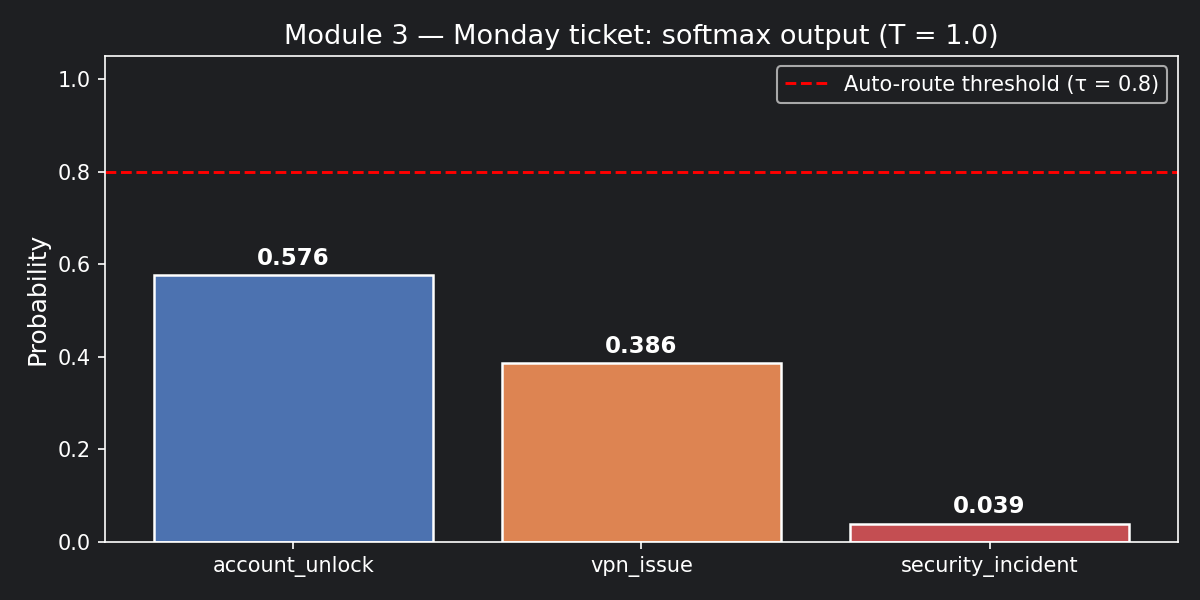
account_unlock:    24.53 / 42.62 = 0.576  (~58%)
vpn_issue:         16.44 / 42.62 = 0.386  (~39%)
security_incident:  1.65 / 42.62 = 0.039  ( ~4%)
                                   ───────
                                   1.001   ✅ (rounding)
These are the canonical numbers for the Monday ticket. Every module that references probabilities for this ticket uses
[0.576, 0.386, 0.039]and logits[3.2, 2.8, 0.5].
Notice: the logit gap between account_unlock and vpn_issue is only 0.4
(3.2 vs 2.8), but after softmax that translates to a probability gap of 0.190
(0.576 vs 0.386). The probabilities are uncomfortably close — nowhere near your
0.80 auto-route threshold. This ticket is genuinely ambiguous.
📊 Visualisation 1 — Default softmax distribution
What happens when the logits are decisive?
Now imagine the ticket said only: "Reset my password please." No VPN mention. No patch notice. Logits:
account_unlock:    5.0
vpn_issue:         1.2
security_incident: -0.4
Softmax:
e^5.0  = 148.41
e^1.2  =   3.32
e^-0.4 =   0.67
           ──────
Total  = 152.40

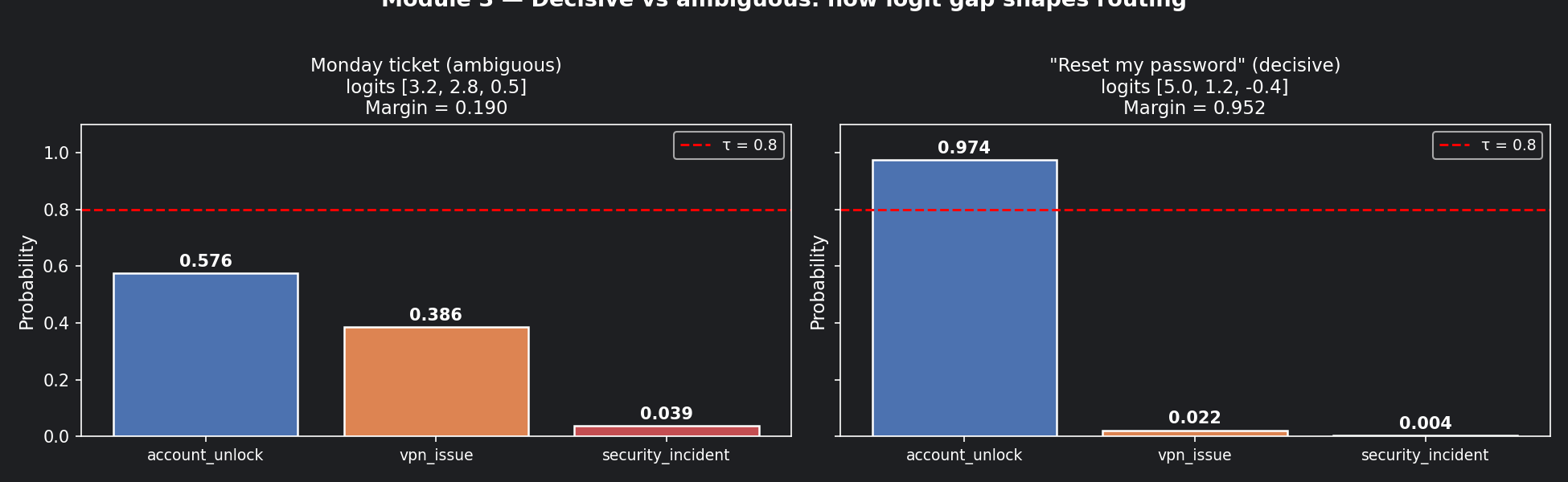
account_unlock:    148.41 / 152.40 = 0.974  (97%)
vpn_issue:           3.32 / 152.40 = 0.022  ( 2%)
security_incident:   0.67 / 152.40 = 0.004  (<1%)
A logit gap of 3.8 produced a probability margin of 0.952. Safe to auto-route.
The pattern to memorise:
- Large logit gaps → peaked distributions → confident routing
- Small logit gaps → flat distributions → send to human or clarification queue
📊 Visualisation 2 — Decisive vs ambiguous ticket side by side

The temperature dial: sharpening or softening the distribution
You can adjust how decisive the softmax output is by adding a temperature parameter \(T\):
| Temperature | Effect | When to use it |
|---|---|---|
| \(T = 1.0\) | Default — no change | Normal routing decisions |
| \(T < 1.0\) (e.g. 0.3) | Sharpens the winner — more decisive | Crisp single-intent routing |
| \(T > 1.0\) (e.g. 2.0) | Flattens the distribution — more options | Generating diverse draft responses |
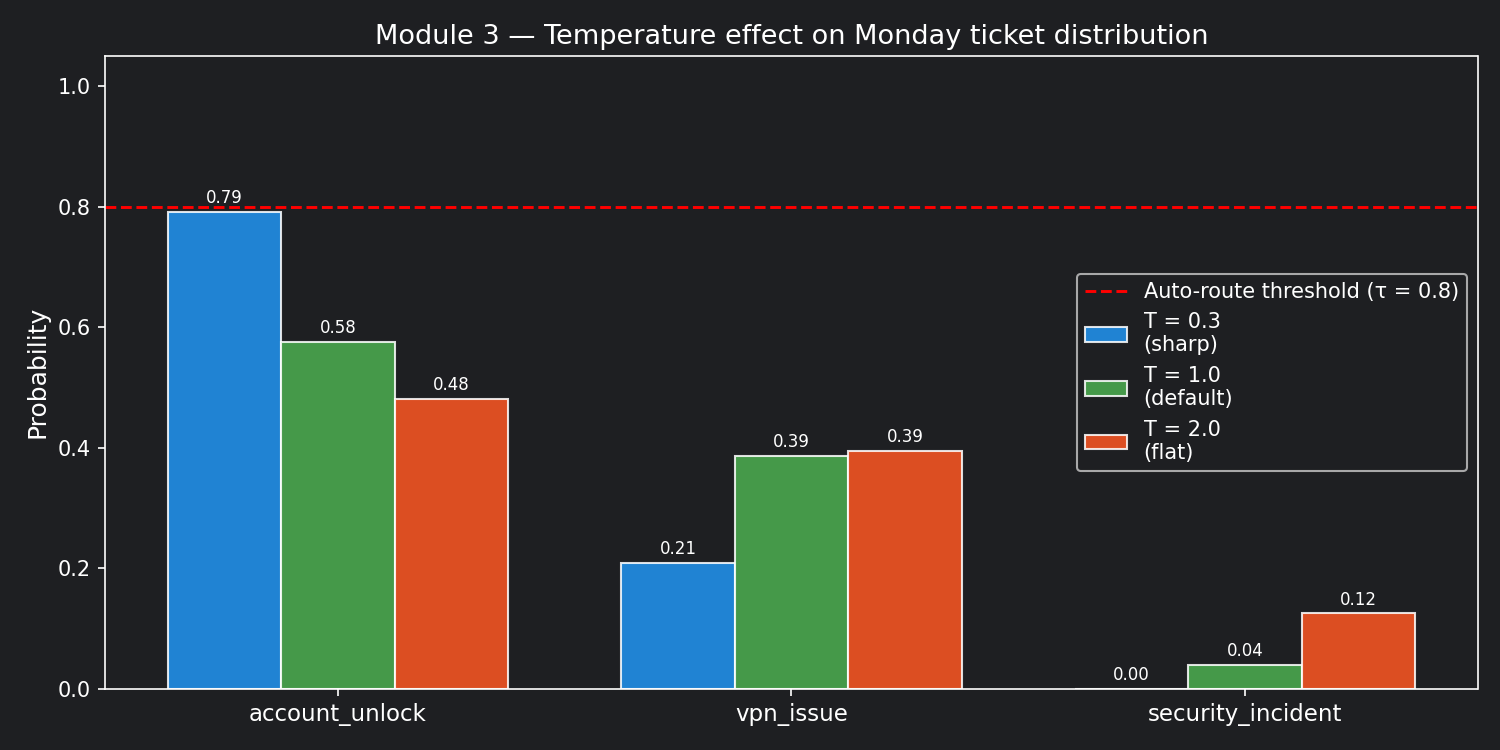
Applied to the Monday ticket logits [3.2, 2.8, 0.5]:
| Temperature | account_unlock | vpn_issue | security_incident | Margin |
|---|---|---|---|---|
| T = 0.3 | 0.910 | 0.089 | 0.001 | 0.821 |
| T = 1.0 | 0.576 | 0.386 | 0.039 | 0.190 |
| T = 2.0 | 0.422 | 0.376 | 0.202 | 0.046 |
At T = 0.3: looks decisive — but nothing changed in the underlying evidence. The model didn't get smarter. You turned up the confidence dial artificially.
At T = 2.0: security_incident jumps to 20%. Nearly indistinguishable from
the other classes. If you were routing on this, you'd be acting on noise.
The critical rule: Low temperature creates the appearance of certainty, not real certainty.
For the Monday ticket — where a misrouted security incident means a potential attacker stays on the network — forcing certainty via temperature hides the ambiguity rather than resolving it.
📊 Visualisation 3 — Temperature effect on the Monday ticket
The metric that matters more than the top score
Stop looking at just the top probability. Start tracking the confidence margin:
| Ticket | Margin | Routing decision |
|---|---|---|
| Monday ticket | 0.190 | 🔁 Clarification queue |
| "Reset my password" | 0.952 | ✅ Auto-route |
A routing policy built on margin is more robust than one built on threshold alone:
| Margin | Routing decision |
|---|---|
| ≥ 0.60 | Auto-route to specialist |
| 0.30 – 0.59 | Route with human-review flag |
| < 0.30 | Clarification queue or escalate |
The Monday ticket has a margin of 0.190 — clarification queue regardless of temperature setting. The evidence is genuinely split.
One implementation trap: numerical instability
Exponentiating large logits causes overflow. e^1000 crashes most systems.
# ❌ Naive — breaks on large logits
probs = np.exp(logits) / np.sum(np.exp(logits))

# ✅ Numerically stable — always use this (already in softmax() above)
logits_shifted = logits - np.max(logits)
probs = np.exp(logits_shifted) / np.sum(np.exp(logits_shifted))
Subtracting the max logit doesn't change the ratios — it prevents your pipeline
from silently producing NaN on edge-case tickets with extreme scores.
How to practice this
Open notebooks/math-foundations/03_logits_softmax.ipynb and work through:
- Run the
softmax()function on the Monday ticket logits[3.2, 2.8, 0.5]— verify the output matches[0.576, 0.386, 0.039] - Run Visualisation 3 and observe how the margin collapses as temperature rises
- Find the temperature at which
security_incidentcrosses 0.15 — what does that mean for your routing policy? - Test the numerically stable softmax against logits
[1000, 999, 0]— compare it to the naive version
Checklist before moving on
- [ ] Can you explain why a logit of 3.2 is not the same as 32% confidence?
- [ ] Do you track the margin (top-1 minus top-2), not just the top score?
- [ ] Is your softmax implementation numerically stable (max subtraction)?
- [ ] Do you know what temperature setting your system uses — and why?
- [ ] Is your routing policy validated against real outcomes, not just held-out test data?