Lab 4 — Core GCP Resources: Modules, Storage, Providers & IAM
Code: 02-gcp-terraform/core-gcp-resources/ · Resources Planned: 16 (+ 2 data sources) · Interactive View: Open Interactive Dashboard
1. Full Architecture Overview
core-gcp-resources is the all-in-one GCP root practicing reusable child modules, provider aliasing (google.us_east), count vs. for_each repetition, dynamic nested blocks, workspaces, and live data sources.
Because this root spans three distinct GCP domains (VPC/Compute, Cloud Storage, and IAM), the full diagram below is followed by three focused zone diagrams so each subsystem is clear at a glance.
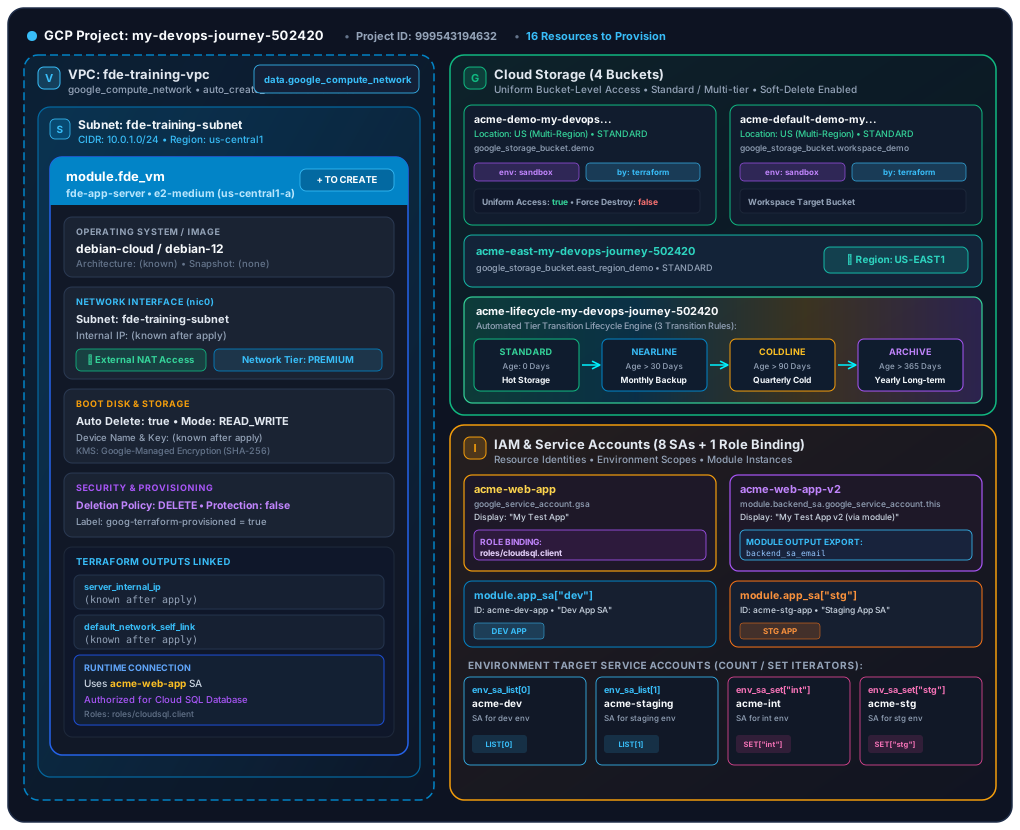
Click any diagram to zoom in full screen, or launch the interactive HTML inspector.
2. Visual Breakdown by Zone (3 Focused Views)
Zone 1 — VPC, Subnet, Live data Source & Reusable VM Module (modules/gcp-vm)
The left zone of the architecture provisions fde-training-vpc, fde-training-subnet (10.0.1.0/24), a live data.google_compute_network lookup, and the module.fde_vm child module:
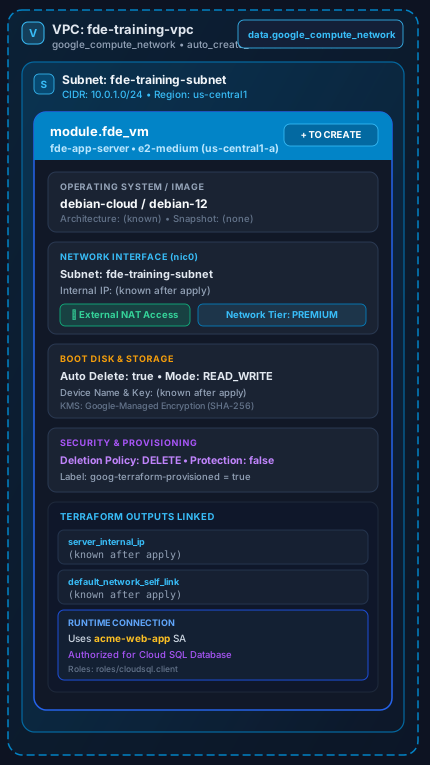
- Default vs. Aliased Provider Inheritance: Child modules (
module.fde_vm,module.backend_sa,module.app_sa) automatically inherit the default (unaliased)provider "google"block frommain.tf. If only an aliased provider (alias = "us_east") is defined in the root, Terraform synthesizes an empty defaultprovider "google" {}with noproject, causingproject: required field is not seterrors. - Input Validation Guardrail (
modules/gcp-vm/variables.tf): Enforces cost compliance atplantime usingcan(regex("^(e2-|n1-|n2-)", var.machine_type)). - Deferred Data Source Read (
<= read): Becausedata.google_compute_network.defaultreferencesgoogle_compute_network.vpc.name(which does not exist untilapply), Terraform automatically defers the data source read untilapplyrather than failing duringplan.
Zone 2 — Cloud Storage: Workspaces, Provider Alias (US-EAST1) & dynamic Lifecycle Rules
The top-right zone provisions 4 GCS buckets demonstrating four distinct Terraform mechanics (resources.tf):
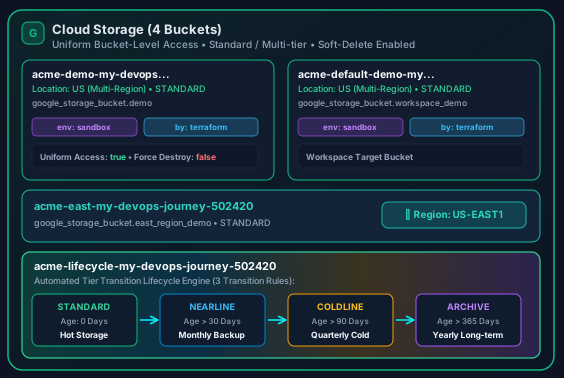
google_storage_bucket.demo: Useslocal.common_labelsand setsuniform_bucket_level_access = trueexplicitly to satisfy GCP Org Policy constraints (constraints/storage.uniformBucketLevelAccess).google_storage_bucket.workspace_demo: Interpolates${terraform.workspace}into the bucket name (acme-default-demo-...) to prevent global GCS naming collisions across workspaces.google_storage_bucket.east_region_demo: Routes to the secondary aliased provider viaprovider = google.us_east(unquoted reference) to provision inUS-EAST1.google_storage_bucket.lifecycle_demo: Uses adynamic "lifecycle_rule"block iterating overlocal.lifecycle_rulesto generate three storage-class transitions (STANDARD→NEARLINE@ 30d →COLDLINE@ 90d →ARCHIVE@ 365d) without repeating nested HCL blocks.
Zone 3 — IAM & Service Accounts (count List vs. for_each Set vs. for_each Module)
The bottom-right zone provisions 8 Service Accounts and 1 Project IAM Binding comparing every Terraform repetition pattern side by side:
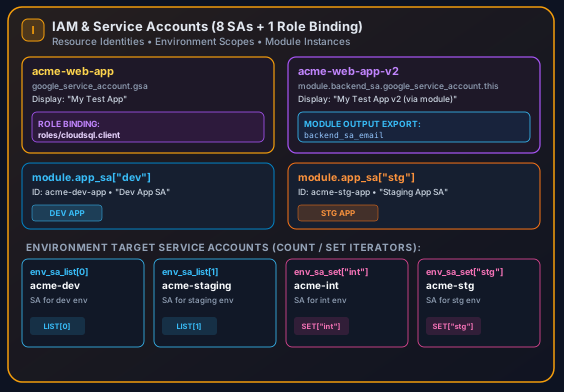
| Address in State | How It Is Created | Key/Index Stability when First Item Removed |
|---|---|---|
google_service_account.gsa + google_project_iam_member.sa_sql_client |
Single resource + implicit reference (member = "serviceAccount:${google_service_account.gsa.email}") |
Single instance |
module.backend_sa.google_service_account.this |
Single child module call (./modules/service_account) |
Single instance |
module.app_sa["dev"], module.app_sa["stg"] |
for_each = var.service_accounts (map(object)) over a module block |
Stable — keyed by map key ("dev", "stg") |
google_service_account.env_sa_set["int"], ["stg"] |
for_each = var.environment_set (set(string)) |
Stable — keyed by string value ("int", "stg") |
google_service_account.env_sa_list[0], [1] |
count = length(var.environment_list) (list(string)) |
Fragile — removing index 0 ("dev") shifts "staging" from [1] → [0], forcing replacement |