Lab 3 — HA VPN with Cloud Router & Dynamic eBGP
Code: 02-gcp-terraform/3-ha-vpn-bgp/ · Resources Planned: 25 · Interactive View: Open Interactive Dashboard
1. Full Topology Overview
In Lab 2 (VPC Peering), GCP exchanged routes between 10.10.0.0/24 and 10.20.0.0/24 automatically in the SDN control plane. In this lab, we connect the exact same two subnets using HA VPN (99.99% SLA) + Cloud Router + Dynamic eBGP across 4 active/active IKEv2 IPsec tunnels.
Because the full 25-resource diagram is rich in detail, it is presented below as a full overview followed by three focused sub-diagrams (Workloads & Firewalls, Cloud Routers & HA VPN Gateways, and the Dual IPsec Tunnel / BGP Mesh Channel).
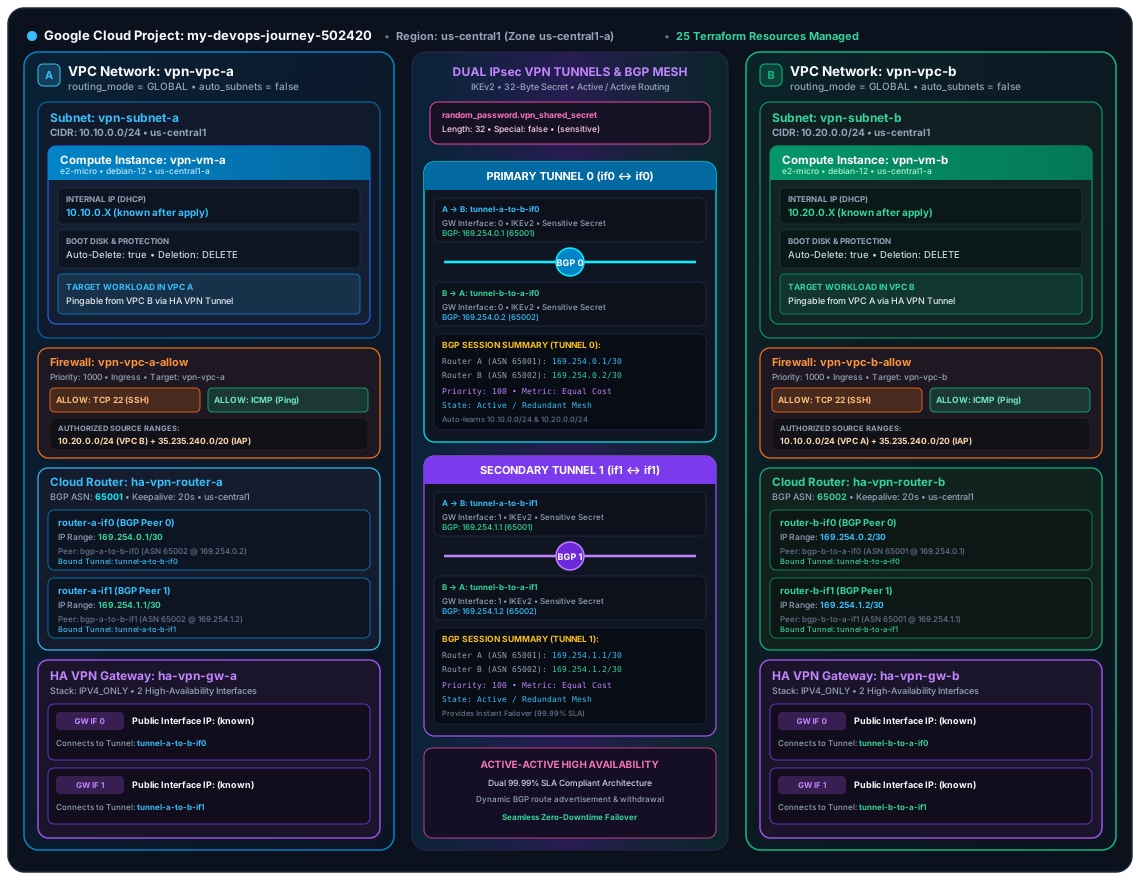
Click any diagram to zoom in full screen, or launch the interactive HTML inspector.
Hourly Tunnel Billing
Unlike VPC Peering, VPN tunnels bill hourly (~$0.05/tunnel/hour × 4 tunnels = ~$0.20/hr). Always run terraform destroy right after testing live BGP sessions.
2. Visual Breakdown by Subsystem (3 Focused Views)
Part A — VPCs (GLOBAL Routing), Subnets, VMs & Ingress Firewalls
Unlike Lab 2 where default REGIONAL routing sufficed, both vpn-vpc-a and vpn-vpc-b set routing_mode = "GLOBAL" so Cloud Router advertises subnets from all regions and programs learned BGP routes VPC-wide:
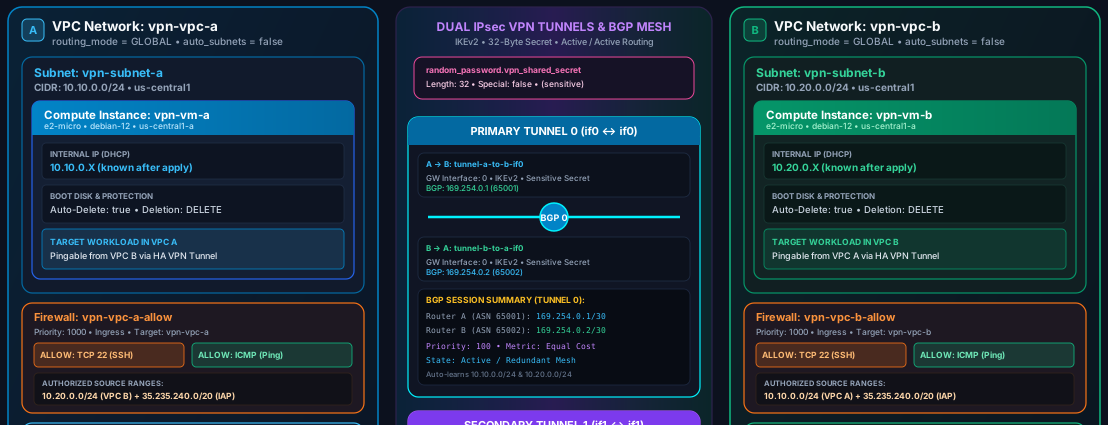
vpn-vpc-a(10.10.0.0/24): Hostsvpn-vm-aand firewallvpn-vpc-a-allow(permits ICMP + TCP22from10.20.0.0/24and IAP35.235.240.0/20).vpn-vpc-b(10.20.0.0/24): Hostsvpn-vm-band firewallvpn-vpc-b-allow(permits ICMP + TCP22from10.10.0.0/24and IAP35.235.240.0/20).
Part B — Control Plane vs. Data Plane: Cloud Routers & HA VPN Gateways
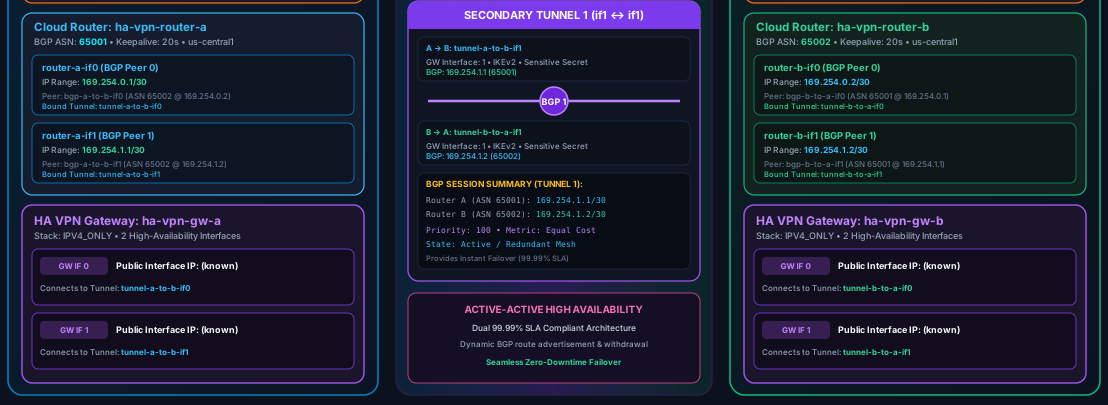
A critical architectural distinction in Google Cloud hybrid networking is the separation between Cloud Router (Control Plane) and HA VPN Gateway (Data Plane):
- Cloud Routers (
ha-vpn-router-a&ha-vpn-router-b) — Pure Control Plane:- User data packets never pass through Cloud Router.
- Cloud Router is purely a BGP speaker that establishes TCP port
179sessions over the tunnel's link-local169.254.x.x/30IPs, exchanges prefix advertisements (10.10.0.0/24↔10.20.0.0/24), and programs next-hop routes into the VPC route table. - Why two different ASNs (
65001vs.65002)? BGP between two autonomous networks uses eBGP (External BGP), which requires distinct private ASNs (64512–65534per RFC 6996).
- HA VPN Gateways (
ha-vpn-gw-a&ha-vpn-gw-b) — Dual-Interface Data Plane:- Each
google_compute_ha_vpn_gatewayautomatically allocates two independent external IPv4 addresses (GW IF 0andGW IF 1) backed by separate physical/logical failure domains in GCP. You never creategoogle_compute_addressresources manually for HA VPN.
- Each
resource "google_compute_router" "router_a" {
  name    = "ha-vpn-router-a"
  network = google_compute_network.network_a.name
  region  = var.region

  bgp {
    asn                = var.asn_a # 65001 (Router B uses 65002)
    advertise_mode     = "DEFAULT" # Automatically advertises all VPC subnets
    keepalive_interval = 20
  }
}

resource "google_compute_ha_vpn_gateway" "ha_gateway_a" {
  name    = "ha-vpn-gw-a"
  network = google_compute_network.network_a.id
  region  = var.region
}
Part C — Dual IPsec Tunnels (if0 ↔ if0, if1 ↔ if1) & 169.254.x.x/30 BGP Mesh
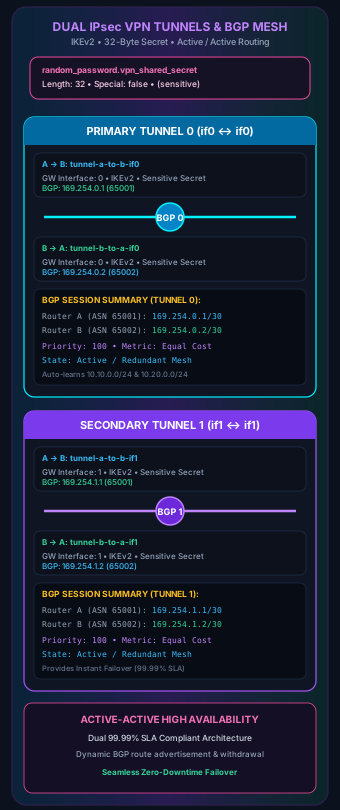
Even after all 4 IKEv2 IPsec tunnels (a_to_b_if0, a_to_b_if1, b_to_a_if0, b_to_a_if1) authenticate using random_password.vpn_shared_secret, no routes exist until BGP peers are bound to each tunnel:
| Tunnel Pair | Gateway Interface | Router A (ASN 65001) |
Router B (ASN 65002) |
Route Priority (MED) | Mode |
|---|---|---|---|---|---|
| Primary Tunnel 0 | if0 ↔ if0 |
169.254.0.1/30 (router-a-if0) |
169.254.0.2/30 (router-b-if0) |
100 |
Active (ECMP) |
| Secondary Tunnel 1 | if1 ↔ if1 |
169.254.1.1/30 (router-a-if1) |
169.254.1.2/30 (router-b-if1) |
100 |
Active (ECMP) |
- Why
169.254.x.x/30? An IPsec tunnel is a virtual point-to-point wire. To run TCP port179(BGP) inside that wire, each end of the tunnel needs an IP from a non-routable RFC 3927 link-local/30subnet (2usable host IPs per/30). - Active/Active ECMP vs. Active/Passive (
advertised_route_priority): Both Tunnel 0 and Tunnel 1 advertise prefixes withadvertised_route_priority = 100(BGP MED — Multi-Exit Discriminator; lower number = higher preference). Because both tunnels have equal cost (100), GCP installs both tunnels simultaneously as Equal-Cost Multi-Path (ECMP) next hops. To make Tunnel 1 a passive standby instead, set itsadvertised_route_priority = 200.
# Bind Tunnel 0 on Router A to 169.254.0.1/30 and peer with Router B (169.254.0.2, ASN 65002)
resource "google_compute_router_interface" "router_a_if0" {
  name       = "router-a-if0"
  router     = google_compute_router.router_a.name
  region     = var.region
  ip_range   = "169.254.0.1/30"
  vpn_tunnel = google_compute_vpn_tunnel.a_to_b_if0.name
}

resource "google_compute_router_peer" "router_a_peer0" {
  name                      = "bgp-a-to-b-if0"
  router                    = google_compute_router.router_a.name
  region                    = var.region
  peer_ip_address           = "169.254.0.2"
  peer_asn                  = var.asn_b # 65002
  advertised_route_priority = 100       # Equal MED (100) on both tunnels => Active/Active ECMP
  interface                 = google_compute_router_interface.router_a_if0.name
}
3. Resource Inventory (25 Resources)
| Layer | Terraform Resource Type | Count | Identifiers |
|---|---|---|---|
| 1. Global VPCs & Subnets | google_compute_network, google_compute_subnetwork |
4 |
network_a, network_b, subnet_a (10.10.0.0/24), subnet_b (10.20.0.0/24) |
| 2. Cloud Routers (Control Plane) | google_compute_router |
2 |
router_a (ASN 65001), router_b (ASN 65002) |
| 3. HA VPN Gateways (Data Plane) | google_compute_ha_vpn_gateway |
2 |
ha_gateway_a, ha_gateway_b (2 auto-allocated public IPs each) |
| 4. Shared Secret & IPsec Tunnels | random_password, google_compute_vpn_tunnel |
5 |
vpn_shared_secret, a_to_b_if0, a_to_b_if1, b_to_a_if0, b_to_a_if1 |
| 5. Router Interfaces & BGP Peers | google_compute_router_interface, google_compute_router_peer |
8 |
router_a_if0/1, router_b_if0/1, router_a_peer0/1, router_b_peer0/1 |
| 6. Firewalls & Test VMs | google_compute_firewall, google_compute_instance |
4 |
a_allow, b_allow, vm_a, vm_b |
4. Verification Commands
# 1. Initialize & validate the 25-resource plan (free)
terraform init
terraform plan

# 2. If applied to test live BGP, inspect all 4 IPsec tunnels
gcloud compute vpn-tunnels list --filter="region:us-central1"

# 3. Verify BGP session status (state: ESTABLISHED) and learned prefixes on Router A
gcloud compute routers get-status ha-vpn-router-a \
  --region=us-central1 \
  --format="yaml(result.bgpPeerStatus, result.bestRoutesForRouter)"

# 4. Inspect VPC A's route table — observe two equal-cost (priority 100) next-hop tunnels for 10.20.0.0/24
gcloud compute routes list --filter="network:vpn-vpc-a"

# 5. Ping vpn-vm-b from vpn-vm-a across the encrypted IPsec tunnel
gcloud compute ssh vpn-vm-a --zone=us-central1-a --tunnel-through-iap \
  --command="ping -c 4 $(terraform output -raw vm_b_ip)"

# 6. Tear down immediately to stop hourly tunnel charges
terraform destroy