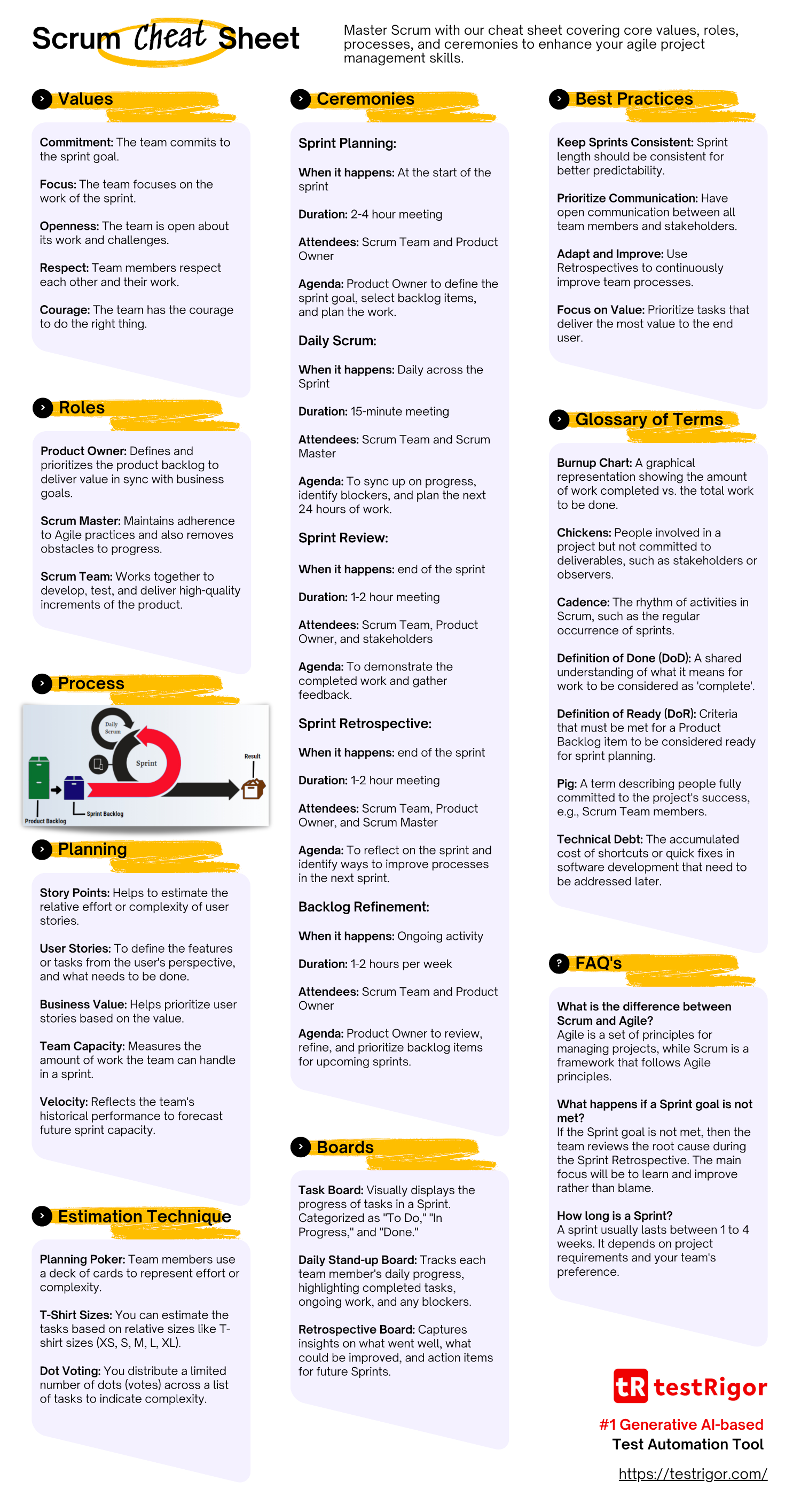
Agile Concepts
Agile Fundamentals
Agile is an iterative approach to software development and project management that emphasizes flexibility, collaboration, and customer satisfaction. The Agile Manifesto (2001) defines four core values:
- Individuals and interactions over processes and tools
- Working software over comprehensive documentation
- Customer collaboration over contract negotiation
- Responding to change over following a plan
Scrum Framework
Scrum is the most popular Agile framework, designed for teams of 3-9 members working in time-boxed iterations called Sprints.
Scrum Roles
- Product Owner (PO): Owns the product backlog, prioritizes work, defines acceptance criteria
- Scrum Master (SM): Facilitates ceremonies, removes impediments, coaches the team
- Development Team: Cross-functional team that delivers the increment (typically 5-7 members)
Scrum Artifacts
Epic
Large body of work that can be broken down into smaller user stories. Epics typically span multiple sprints and represent major features or initiatives.
- Example: “Implement user authentication system”
- Timeline: Multiple sprints (weeks to months)
User Story
A small, valuable piece of functionality written from the end-user perspective.
- Format: “As a [user type], I want [goal] so that [reason]”
- Example: “As a user, I want to reset my password so that I can regain access to my account”
- Size: Should be completable within one sprint
Task
A technical piece of work required to complete a user story.
- Example: “Create database migration for password reset tokens”
- Size: Few hours to 2 days
Spike
A time-boxed research or investigation activity to answer a question or gather information.
- Purpose: Reduce technical uncertainty, explore solutions
- Example: “Research best OAuth 2.0 libraries for our tech stack”
- Timeline: Usually 1-3 days, always time-boxed
Bug
A defect or issue in existing functionality that needs to be fixed.
Technical Debt
Code that needs refactoring or improvement to maintain system quality.
Story Points vs Hours
Story Points (Recommended by Scrum Guide):
- Relative measure of effort, complexity, and uncertainty
- Common scales: Fibonacci (1, 2, 3, 5, 8, 13, 21) or T-shirt sizes (XS, S, M, L, XL)
- Focus on relative sizing, not absolute time
Hours (Traditional approach):
- Absolute time estimates
- Less preferred in Agile due to variability and estimation difficulties
Agile Ceremonies (Events)
Sprint
What: Fixed time-box (iteration) for completing work
- Duration: 1-4 weeks (2 weeks is most common in industry)
- Original Recommendation: 2-4 weeks (Scrum Guide)
- Output: Potentially shippable product increment
Sprint Planning
What: Team plans the work for the upcoming sprint
- Duration: Max 8 hours for 4-week sprint (typically 2-4 hours for 2-week sprint)
- Participants: Entire Scrum Team
-
Goals:
- Define Sprint Goal
- Select items from Product Backlog
- Create Sprint Backlog with detailed tasks
- When: First day of the sprint
Daily Standup (Daily Scrum)
What: Brief daily sync to inspect progress and adapt plan
- Duration: 15 minutes (time-boxed)
- Participants: Development Team (PO and SM optional)
-
Format: Each team member answers:
- What did I do yesterday?
- What will I do today?
- Are there any impediments?
- When: Same time every day
- Industry Practice: Often happens in morning (9-10 AM)
Backlog Refinement (Grooming)
What: Review and prepare backlog items for future sprints
- Duration: ~10% of sprint capacity (2-4 hours per 2-week sprint)
- Participants: PO, SM, and Development Team members
-
Goals:
- Add details, estimates, and acceptance criteria
- Break down large items
- Re-prioritize based on value
- When: Mid-sprint, ongoing activity (not an official Scrum event but widely practiced)
Estimation Techniques
Planning Poker
What: Collaborative estimation technique where team members independently estimate story points
-
Process:
- PO presents user story
- Team discusses and asks questions
- Each member selects a card (Fibonacci: 1, 2, 3, 5, 8, 13, 21)
- All reveal cards simultaneously
- Discuss differences (especially highest and lowest)
- Re-vote until consensus
- Benefits: Reduces anchoring bias, encourages discussion, builds shared understanding
Story Pointing
What: Assigning relative effort estimates to user stories
-
Factors Considered:
- Complexity: How difficult is the work?
- Uncertainty: How much is unknown?
- Effort: How much work is involved?
- Scale: Fibonacci sequence (1, 2, 3, 5, 8, 13, 21) or T-shirt sizes (XS, S, M, L, XL)
- Reference Story: Teams often use a well-understood story as baseline (e.g., “Login is a 5”)
The Three Amigos
What: Collaboration between three perspectives before development begins
- Who: Product Owner (Business) + Developer (Technical) + Tester (Quality)
- When: During backlog refinement or before sprint planning
-
Goals:
- Clarify requirements and acceptance criteria
- Identify edge cases and test scenarios
- Discuss technical approach
- Ensure shared understanding
- Duration: 30-60 minutes per story
- Output: Well-defined story with clear acceptance criteria and test cases
Parking Lot
What: A place to capture off-topic discussions or issues that arise during meetings
- Purpose: Keep meetings focused while acknowledging important topics
-
Process:
- Write item on parking lot (board, doc, or backlog)
- Continue with meeting agenda
- Address parking lot items after meeting or in appropriate forum
- Common Uses: New ideas during sprint planning, technical discussions during standup, impediments that need separate attention
Bullpen
What: Open workspace arrangement where team members sit together
- Purpose: Facilitate communication, collaboration, and osmotic learning
-
Characteristics:
- Co-located team members
- Minimal barriers between team members
- Easy to overhear conversations (information radiators)
- Quick ad-hoc discussions
- Modern Practice: With remote work, “virtual bullpen” through always-on video/chat channels
Sprint Review (Demo)
What: Inspect the increment and adapt the Product Backlog
- Duration: Max 4 hours for 4-week sprint (typically 1-2 hours for 2-week sprint)
- Participants: Scrum Team + Stakeholders
-
Goals:
- Demo completed work
- Gather feedback
- Discuss what’s next
- When: Last day of sprint (or second-to-last day)
Sprint Retrospective (Retro)
What: Team reflects on process and identifies improvements
- Duration: Max 3 hours for 4-week sprint (typically 1-1.5 hours for 2-week sprint)
- Participants: Scrum Team only
-
Goals:
- What went well?
- What didn’t go well?
- What will we improve next sprint?
- When: After Sprint Review, before next Sprint Planning
- Industry Practice: Action items are tracked and reviewed
Typical 2-Week Sprint Timeline
Week 1:
- Monday 9:00 AM: Sprint Planning (2-3 hours)
- Tuesday-Friday 9:00 AM: Daily Standup (15 min)
- Wednesday 2:00 PM: Backlog Refinement (2 hours)

Week 2:
- Monday-Thursday 9:00 AM: Daily Standup (15 min)
- Thursday 2:00 PM: Sprint Review (1-2 hours)
- Friday 9:00 AM: Sprint Retrospective (1-1.5 hours)
- Friday 11:00 AM: Next Sprint Planning (2-3 hours)
Scrum Metrics
Velocity
Average story points completed per sprint over time. Used for capacity planning.
- Industry Practice: Calculate as rolling average of last 3-5 sprints
Burndown Chart
Shows remaining work in the sprint over time. Helps track if team is on track.
Burnup Chart
Shows completed work over time. Better for tracking scope changes.
Sprint Commitment vs Completion
Percentage of committed work actually completed. Target: 80-100%
Scrum Board
A visual representation of work status, typically with columns:
- To Do: Work selected but not started
- In Progress: Currently being worked on
- Review/Testing: Completed but awaiting validation
- Done: Meets Definition of Done
Industry Practice: Many teams add additional columns like “Code Review”, “QA Testing”, or “Blocked”
A Scrum board is visible in both:
- Plan mode: Backlog view for future work
- Work mode: Active Sprint view for current work
Definition of Done (DoD)
A shared understanding of what “complete” means for a user story or increment.
Typical DoD checklist:
- Code written and reviewed
- Unit tests written and passing (>80% coverage)
- Integration tests passing
- Documentation updated
- Acceptance criteria met
- Deployed to staging environment
- Product Owner accepted
Jira Board
JIRA Agile (Jira Software) is a popular tool for Scrum teams.
- Everything in JIRA is called an issue
- Types: Epic, Story, Task, Bug, Spike, Sub-task
- Each issue can be assigned, estimated, and tracked
- JIRA tracks Burndown Chart, Velocity Chart, Sprint Reports
Two Agile modes:
- Scrum: For teams with fixed-length sprints and defined ceremonies
- Kanban: For continuous flow, no sprints, WIP limits
Jira Concepts
Epics: Like buckets grouping similar user stories
Versions: Software releases with new features (used for release planning)
Components: Architectural areas or team boundaries
Labels: Flexible tagging for additional categorization
Kanban vs Scrum
| Aspect | Scrum | Kanban |
|---|---|---|
| Iterations | Fixed sprints | Continuous flow |
| Roles | PO, SM, Dev Team | No prescribed roles |
| Ceremonies | 5 ceremonies | Optional standup |
| Changes | No mid-sprint changes | Changes anytime |
| Metrics | Velocity, Burndown | Lead time, Cycle time |
| Best For | Fixed deadlines, predictable delivery | Continuous delivery, support |
Industry Best Practices
- Keep sprints consistent: Don’t change sprint length frequently
- Limit WIP (Work In Progress): Focus on finishing over starting
- Definition of Ready: Ensure stories are ready before Sprint Planning
- Protect sprint scope: Avoid adding work mid-sprint
- Time-box everything: Respect ceremony time limits
- Automate: CI/CD pipelines for faster feedback
- Co-location or video: Face-to-face communication when possible
- Sprint Goal: Every sprint should have a clear, singular goal
- Team stability: Keep teams together for at least 3-6 sprints
- Continuous improvement: Actually implement retro action items
Story Points
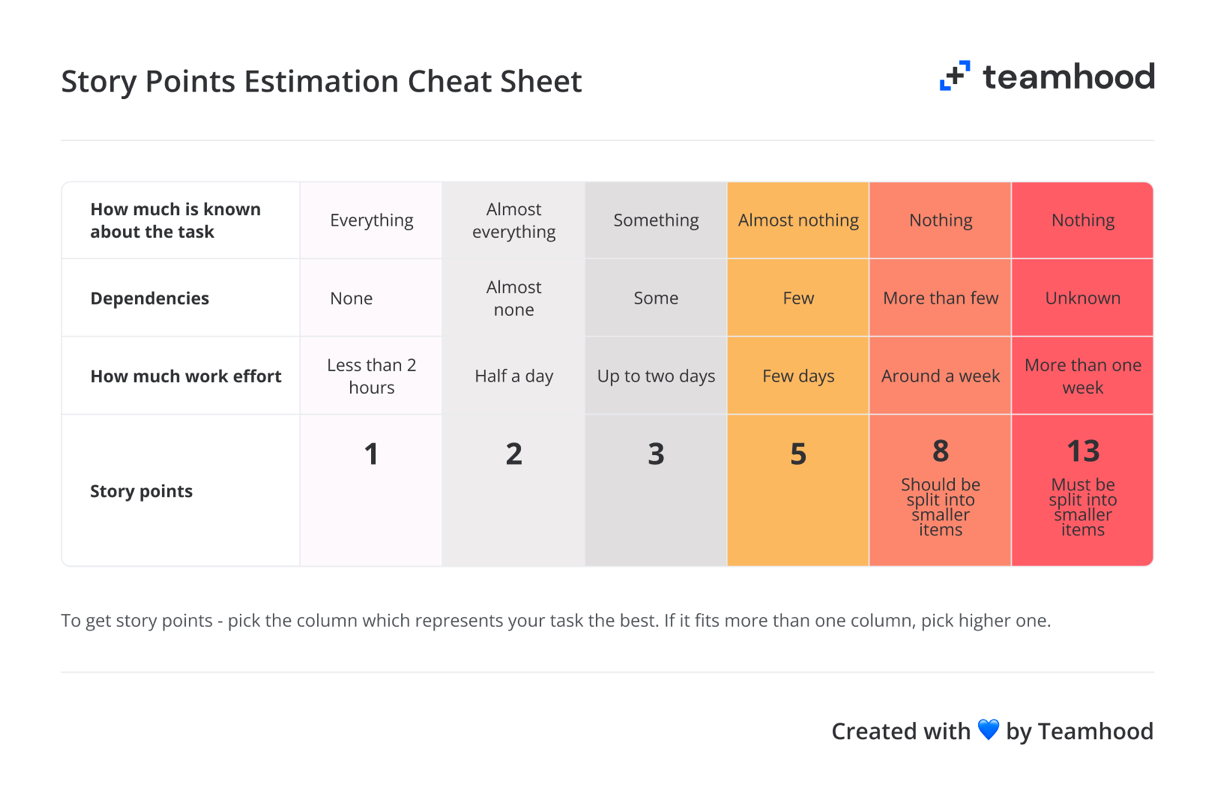
Cheatsheet