Java Multithreading - Part 5: Synchronization Mechanisms
Part 5: Synchronization Mechanisms
This part covers the core synchronization mechanisms in Java: synchronized keyword, volatile, and atomic variables.
Table of Contents
- The synchronized Keyword
- Object-Level vs Class-Level Locks
- The volatile Keyword
- Atomic Variables
- Happens-Before Relationship
- Choosing the Right Tool
The synchronized Keyword
synchronized ensures that only one thread can execute a block of code at a time. It provides both mutual exclusion and memory visibility.
Synchronized Method
When you declare a method as synchronized, the thread acquires the lock on the object (or class for static methods) before executing.
public synchronized void method() {
    // Only one thread per object instance can execute this
}
Synchronized Block
For finer control, synchronize only a portion of the method:
public void method() {
    // Non-critical code (can run concurrently)

    synchronized (lockObject) {
        // Critical section - only one thread at a time
    }

    // Non-critical code
}
Types of Lock Objects
synchronized (this)           // Lock on current object instance
synchronized (MyClass.class)  // Lock on Class object (for static)
synchronized (customLock)     // Lock on any object
Synchronized Block Advantage
More granular control - lock only what’s necessary:
private final Object lock = new Object();

public void method() {
    doSomeWork();  // Multiple threads can run this

    synchronized (lock) {
        // Only critical code is locked
        counter++;
    }

    doMoreWork();  // Multiple threads can run this
}
📁 Code: raceCondition/dSynchronization/S3SynchronizedMethodDemo.java
Object-Level vs Class-Level Locks
Understanding the difference is crucial for correct synchronization.
Object-Level Lock (Instance Lock)
// Lock is on 'this' object instance
public synchronized void instanceMethod() { }

// Equivalent to:
public void instanceMethod() {
    synchronized (this) { }
}
Key Point: Different objects = Different locks!
Two threads accessing the same synchronized method on different objects can run simultaneously.
Counter c1 = new Counter();
Counter c2 = new Counter();

// Thread 1 on c1.increment() and Thread 2 on c2.increment()
// CAN run simultaneously! (different locks)
Class-Level Lock (Static Lock)
// Lock is on the Class object
public static synchronized void staticMethod() { }

// Equivalent to:
public void staticMethod() {
    synchronized (MyClass.class) { }
}
Key Point: One lock for entire class!
All threads share the same lock regardless of which object they use.
Visual Comparison
Object Lock:                    Class Lock:
┌─────────┐ ┌─────────┐        ┌───────────────────┐
│  obj1   │ │  obj2   │        │    Class Lock     │
│  Lock   │ │  Lock   │        │     (one)         │
└────┬────┘ └────┬────┘        └─────────┬─────────┘
     ↑           ↑                       ↑
   T1,T3       T2,T4               T1,T2,T3,T4

Different objects can             All threads compete
run simultaneously               for same lock
⚠️ Key Rule: Synchronization only works when threads operate on the SAME lock!
The volatile Keyword
volatile provides visibility guarantee but does NOT provide atomicity.
Volatile variables are stored in main memory and their changes are visible to all threads immediately.
- The volatile keyword prevents the CPU from caching the variable’s value in a local register or cache.
Atomicity - No Guarantee
The volatile keyword does not guarantee atomicity for compound operations (e.g., incrementing a variable, count++).
- It only ensures that the latest value of the variable is visible across threads
- For atomic operations, additional synchronization mechanism or atomic classes (like
AtomicInteger) are needed
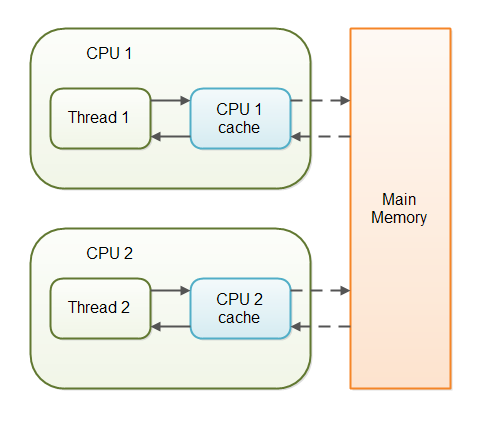
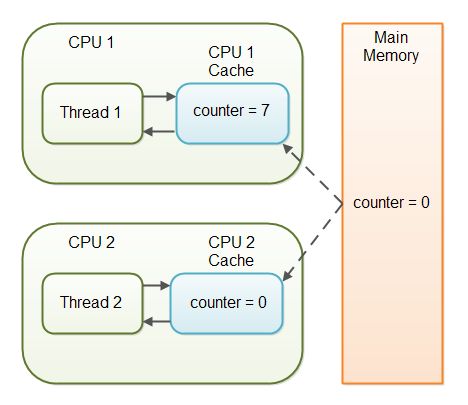
The Memory Visibility Problem
Without volatile, threads may cache variable values in CPU registers/cache:
Without volatile:
┌───────────────────┐    ┌───────────────────┐
│    Thread 1       │    │    Thread 2       │
│  ┌─────────────┐  │    │  ┌─────────────┐  │
│  │ CPU Cache   │  │    │  │ CPU Cache   │  │
│  │ flag = true │  │    │  │ flag = false│  │ ← Stale!
│  └──────┬──────┘  │    │  └──────┬──────┘  │
└─────────┼─────────┘    └─────────┼─────────┘
          │                        │
          ▼                        ▼
    ┌─────────────────────────────────────┐
    │           Main Memory               │
    │          flag = true                │
    └─────────────────────────────────────┘
Volatile Solution
Volatile variables are stored in main memory and changes are visible to all threads immediately.
private volatile boolean running = true;

// Thread 1                    // Thread 2
running = false;              while (running) { }
                              // Sees change immediately!
What volatile Guarantees
- Visibility: Changes are immediately visible to all threads
- No Caching: Prevents CPU from caching the variable
- Happens-Before: Writes happen-before subsequent reads
- No Reordering: Reads/writes cannot be reordered
What volatile Does NOT Guarantee
Atomicity for compound operations!
private volatile int counter;

// Still NOT atomic - still has race condition!
counter++;  // Read + Increment + Write

// Still needs synchronization for compound operations
volatile vs synchronized
| Feature | volatile | synchronized |
|---|---|---|
| Visibility | ✅ Yes | ✅ Yes |
| Atomicity | ❌ No | ✅ Yes |
| Blocking | ❌ No | ✅ Yes (waits for lock) |
| Use Case | Simple flags, single read/write | Compound operations |
Volatile Implementation
The JVM uses memory barriers (fences):
- Store Barrier: Ensures writes to volatile aren’t reordered with preceding writes
- Load Barrier: Ensures reads of volatile aren’t reordered with following reads
volatile int sharedVar = 0;

public void task() {
    // All instructions WILL be executed before
    write(sharedVar);  // Memory barrier here
    // All instructions will be executed after
}
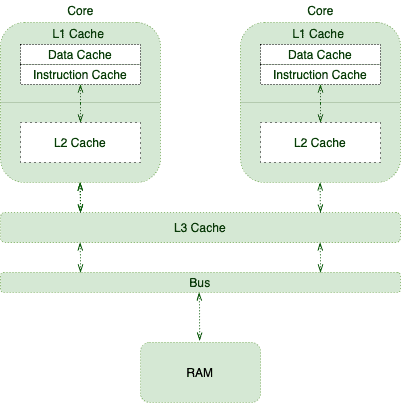
Shared Multiprocessor Architecture
Also see: Shared Multiprocessor Architecture (Baeldung)
| Other Variables | One Possible State |
|---|---|
 |
 |
📁 Code: raceCondition/eVolatileVar/VolatileTest.java
Atomic Variables
Atomic classes in java.util.concurrent.atomic package provide lock-free thread-safe operations using CAS (Compare-And-Swap).
Available Types
-
AtomicInteger,AtomicLong,AtomicBoolean -
AtomicReference<T>for object references -
AtomicIntegerArray,AtomicLongArray,AtomicReferenceArray
AtomicInteger Example
int initialValue = 0;
AtomicInteger atomicInteger = new AtomicInteger(initialValue);

// Increment operations
int previousValue = atomicInteger.getAndIncrement(); // counter++ (returns OLD)
int updatedValue = atomicInteger.incrementAndGet();  // ++counter (returns NEW)

// Add operations
atomicInteger.addAndGet(5);     // Returns new value
atomicInteger.getAndAdd(5);     // Returns old value

// Read
int value = atomicInteger.get();

// CAS (Compare-And-Set)
atomicInteger.compareAndSet(expected, newValue);
Method Summary
| Method | Description | Return |
|---|---|---|
get() |
Get current value | Current value |
set(v) |
Set value | void |
incrementAndGet() |
++value | New value |
getAndIncrement() |
value++ | Old value |
addAndGet(delta) |
value += delta | New value |
compareAndSet(e, n) |
Set if current == expected | true if successful |
Pros and Cons
Pros:
- Simplicity
- No synchronization or locks needed
- No race conditions or data races
Cons:
- Only the operation itself is atomic
- Race condition between 2 separate atomic operations:
AtomicInteger atomicInteger = new AtomicInteger(0);

int a = atomicInteger.incrementAndGet();
int b = atomicInteger.addAndGet(-1);  // RACE CONDITION between these!
AtomicLong and AtomicDouble
For long and double (64-bit values):
AtomicLong atomicLong = new AtomicLong();
atomicLong.incrementAndGet();
long value = atomicLong.get();
Note: AtomicDouble is not in standard library - available in Google Guava.
AtomicReference
For atomic operations on object references:
AtomicReference<MyObject> atomicRef = new AtomicReference<>(new MyObject());

// Atomic assignment
atomicRef.set(newValue);

// Atomic read
MyObject obj = atomicRef.get();

// CAS
atomicRef.compareAndSet(expectedObj, newObj);
📁 Code: raceCondition/fAtomicVar/AtomicIntCounter.java
Happens-Before Relationship
The Happens-Before relationship guarantees ordering between operations.
Rules
- Program Order: Within a thread, each action happens-before subsequent actions
- Monitor Lock: Unlock happens-before subsequent lock on same monitor
- Volatile: Write to volatile happens-before subsequent reads
-
Thread Start:
start()happens-before any action in started thread -
Thread Join: All actions in thread happen-before
join()returns - Transitivity: If A happens-before B, and B happens-before C, then A happens-before C
volatile and Happens-Before
volatile int x;
int y;

// Thread 1
y = 1;      // (1)
x = 1;      // (2) - volatile write

// Thread 2
if (x == 1) {  // (3) - volatile read
    // y is GUARANTEED to be 1 here
    // Because (1) happens-before (2) (program order)
    // And (2) happens-before (3) (volatile rule)
    // So (1) happens-before (3) (transitivity)
}
Choosing the Right Tool
Decision Tree
Need thread safety?
│
├── Single boolean flag?
│   └── volatile
│
├── Single counter/number?
│   └── AtomicInteger/AtomicLong
│
├── Single reference?
│   └── AtomicReference<T>
│
├── Multiple variables together?
│   └── synchronized
│
├── Compound check-then-act?
│   └── synchronized or Lock
│
└── Complex operations?
    └── ReentrantLock (Part 6)
Comparison Table
| Feature | synchronized | volatile | Atomic |
|---|---|---|---|
| Mutual Exclusion | ✅ Yes | ❌ No | ❌ No |
| Visibility | ✅ Yes | ✅ Yes | ✅ Yes |
| Atomicity | ✅ Yes | ❌ No | ✅ Single op |
| Blocking | Yes | No | No |
| Performance | Slower | Fast | Fast |
| Use Case | Compound ops | Flags | Counters |
Best Practices
- Minimize synchronized scope - Only lock what’s necessary
- Use appropriate tools - volatile for flags, Atomic for counters
- Prefer higher-level constructs - Concurrent collections when possible
- Understand your locks - Same lock = mutual exclusion
Summary
✅ synchronized provides mutual exclusion + visibility (blocking)
✅ Object lock vs Class lock - different scopes
✅ volatile provides visibility only, not atomicity
✅ Atomic classes provide lock-free atomic operations via CAS
✅ Happens-Before guarantees ordering of operations
Quick Reference
// Synchronized method
public synchronized void method() { }

// Synchronized block
synchronized (lock) { }

// Volatile flag
private volatile boolean running = true;

// Atomic counter
AtomicInteger counter = new AtomicInteger(0);
counter.incrementAndGet();
counter.compareAndSet(expected, newValue);