Java Multithreading - Part 4: Race Conditions & Critical Sections
Part 4: Race Conditions & Critical Sections
This part dives deep into the problems that arise when multiple threads access shared resources - race conditions and data races.
Shared Resources
What Can Be Shared?
- Variables (Class level, static, etc.)
- Data structures (Objects)
- File or Connection handles
- Message queues or Work Queues
- Any Other Object
Memory Sharing
- Heap Memory is shared among all threads
- Stack is created for each thread, so variables on Stack aren’t shared
Concurrent vs Distributed Systems
Concurrent systems -> different threads communicate with each other
Distributed Systems -> different processes communicate.
Historical Note
Reentrant Locks and Semaphores are introduced in Java 1.5
- Reentrant Locks (Mutex) allows only one thread in a critical section.
- Semaphore allows a fixed number of threads to access a critical section.
The Risk
When multiple threads access shared resources:
- Without proper synchronization → Race conditions
- Without proper visibility → Data races
Atomic Operations
Definition
Atomic Operation: An operation that completes in a single step relative to other threads.
- All-or-Nothing: The operation either completes fully or doesn’t start at all
- Indivisibility: No other operations can interleave or interrupt the atomic operation
What’s Atomic in Java?
Atomic by default:
- Read & Assignment on all primitive types (except long and double)
- Read & Assignment on all references
- Read & Assignment on all volatile long and double
What’s NOT Atomic?
counter++ is NOT atomic! It involves 3 steps:
// This looks like one operation but it's actually THREE:
counter++;

// Step 1: READ - Fetch the current value of counter from memory
// Step 2: TEMP WRITE - Increment the fetched value by 1
// Step 3: ASSIGNMENT - Store the incremented value back into counter
This is why counter++ is a non-atomic operation and prone to race conditions.
Non-Atomic Operation Explained
Non-Atomic operation - A single Java operation (eg. count++) turns into two or more hardware operations:
- fetch current value of count
- perform count+1
- reassign back to count
private int counter;
public void increment() {
    counter++;
}

public void decrement() {
    counter--;
}
If two threads execute counter++ simultaneously, they could both fetch the same initial value of counter, increment it, and then store the same new value, resulting in one increment instead of two.
This is a race condition.
Race Conditions
Definition
A race condition occurs when:
- Multiple threads accessing shared resources
- At least one thread is modifying the shared resources
- The timing of thread scheduling may cause incorrect results
- The core problem is non-atomic operations on shared resource
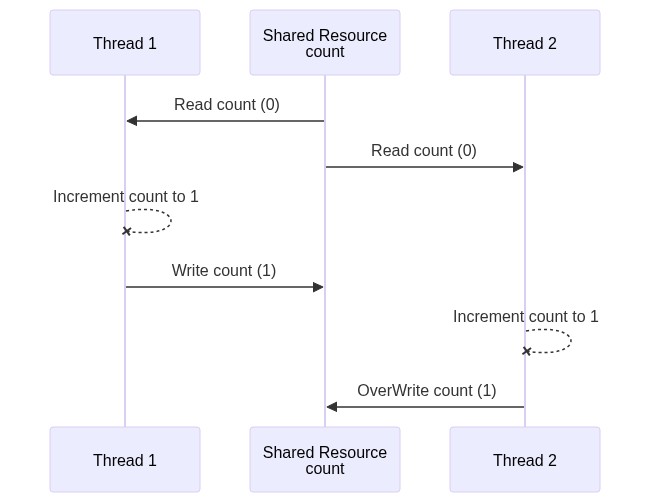
Interleaved Execution with a Shared Resource
Visual Example: Both Threads Incrementing (Text Diagram)
Thread 1                    Thread 2
─────────────────────────────────────────────
1. Read counter (0)
2. Increment (0→1)          1. Read counter (0)  ← Same value!
3. Write counter (1)        2. Increment (0→1)
                            3. Write counter (1)  ← Lost update!

Expected: counter = 2
Actual: counter = 1 (LOST UPDATE!)
Visual Example: Both Threads Incrementing with NO COMMUNICATION (Mermaid)
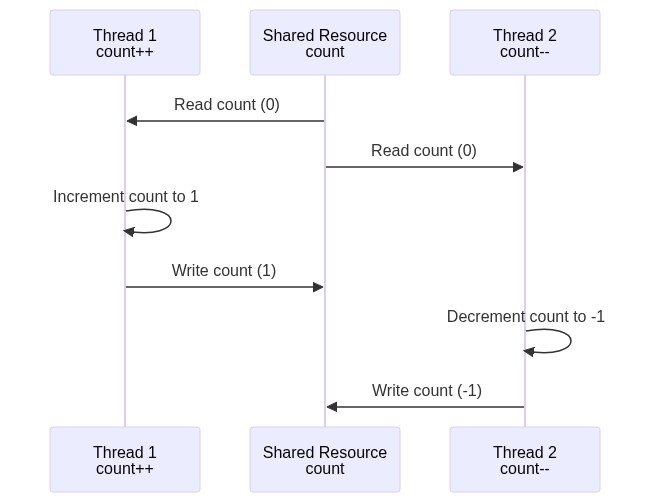
Visual Example: One Incrementing, One Decrementing
sequenceDiagram
    participant T1 as Thread 1 (count++)
    participant SR as Shared Resource (count)
    participant T2 as Thread 2 (count--)

    SR->>T1: Read count (0)
    SR->>T2: Read count (0)
    T1->>T1: Increment count to 1
    T1->>SR: Write count (1)
    T2->>T2: Decrement count to -1
    T2->>SR: Write count (-1)
Result: Final value is -1, but should be 0!
Visual Example: One Incrementing, One Decrementing (Alternative Mermaid)
Code Example
// PROBLEM: counter++ is NOT atomic (read→increment→write)
private int counter = 0;

public void increment() {
    counter++;  // Race condition!
}

public void decrement() {
    counter--;  // Race condition!
}
📁 Code: raceCondition/dSynchronization/S0NonSyncProblems.java
Race Condition Solution
Ensuring Atomicity
Identify and protect the critical section:
- Using synchronized keyword
- on the method - monitor
- using synchronized block - more granularity & flexibility but verbose
- Using AtomicInteger
Critical Sections
Definition
Critical Section: Parts of code that access shared resources and must be protected to prevent concurrent access issues.
Visualization
Thread 1        Critical Section        Thread 2
    │               │                       │
    ├──────────────▶│ counter++             │
    │               │ (LOCKED)              │
    │               │◀──────────────────────┤ Wait...
    │               │                       │
    ├───────────────┤ Exit                  │
    │               │──────────────────────▶│
    │               │ counter++             │
Protection Methods
- Synchronized Methods and Synchronized Blocks (with lock object) ensure that only one thread can access a critical section at a time.
- ReentrantLocks offer more control and flexibility compared to synchronized blocks.
- Atomic Variables - for simple operations
-
Concurrent Collections are thread-safe and can simplify handling shared data without manual synchronization.
- Examples: ConcurrentHashMap, CopyOnWriteArrayList, BlockingQueue
Mutual Exclusion
When using synchronized:
// Run by increment thread
public synchronized void increment() {
    count++;
}

// Run by decrement thread
public synchronized void decrement() {
    count--;
}
- When thread1 is executing
increment(), thread2 can’t executedecrement() - When thread2 is executing
decrement(), thread1 can’t executeincrement() - Both methods are synchronized and belong to the same object (counter)
That is because both methods are synchronized, and belong to the same object (counter).
📁 Code: raceCondition/dSynchronization/S0NonSyncProblemsSolved.java
Data Race
Definition
A Data Race is different from a race condition. It’s about instruction ordering and visibility.
Example Question
Is x strictly greater than y?
private int x = 0, y = 0;

public void increment() {
    x++;  // Does this always run before y++?
    y++;
}

// Check for the above hypothesis
public void checkForDataRace() {
    if (y > x)
        System.out.println("y > x - Data Race is detected");
}
Scenario:
- One thread running
increment()method in a loop - One checker thread just to see if Data Race occurs
Surprising Result: y > x can happen! Why?
Code Rearrangement
Why Does Data Race Occur?
Compiler and CPU may execute instructions out of order (if the instructions are independent) to optimize performance.
- The logical correctness of the code is always maintained
Logical Correctness is Maintained
- Within a single thread, the visible result is correct
- But across threads, the intermediate states can be visible
What Compiler Rearranges For
The compiler re-arranges the instructions for better:
-
Branch prediction (optimized loops,
ifstatements, etc.) - Vectorization - parallel instruction execution (SIMD)
- Prefetching instructions - better cache performance
What CPU Rearranges For
The CPU rearranges the code for better:
- Better hardware units utilization
Example: Cannot Be Rearranged
The following can’t be rearranged as all instructions are interdependent:
-
ydepends onxandzdepends ony
// y depends on x, z depends on y - can't be swapped
x = 1;
y = x * 2;
z = y + 1;
Example: Can Be Rearranged
The following code may be arranged by the Compiler or CPU - leading to unexpected, paradoxical, and incorrect results:
// These are INDEPENDENT - can be swapped!
x++;
y++;
// OR
y++;
x++;
The Problem
Code rearrangement can lead to:
- Unexpected results
- Paradoxical states
- Incorrect behavior in multithreaded programs
Solutions Overview
For Race Conditions
Ensure Atomicity - Identify and protect the critical section:
-
Using
synchronizedkeyword- On the method (monitor)
- Using synchronized block (more granularity & flexibility)
- Using AtomicInteger
For Data Races
Establish Happens-Before semantics:
-
Synchronization of methods
- Solves both race and data condition
- Performance penalty
-
Volatile shared variables
- Solves race condition for read/write from long and double
- Solves all data races by guaranteeing order
- volatile shared variables
Rule of Thumb
Every shared variable (modified by at least one thread) should be either:
- Guarded by a synchronized block (or any type of lock) OR
- Declared volatile
Choosing the Right Tool
Need thread safety?
├── Single flag? → volatile
├── Single counter? → AtomicInteger
├── Multiple variables together? → synchronized
└── Complex operations? → Lock (ReentrantLock)
Comparison of Solutions
| Solution | Race Condition | Data Race | Performance |
|---|---|---|---|
| synchronized | ✅ Solved | ✅ Solved | Slower (blocking) |
| volatile | ❌ Not for compound ops | ✅ Solved | Fast (no blocking) |
| AtomicInteger | ✅ For single var | ✅ Solved | Fast (CAS) |
| ReentrantLock | ✅ Solved | ✅ Solved | Flexible |
Key Takeaways
Race Condition Conditions
- Multiple threads accessing shared resources
- At least one thread modifying
- Non-atomic operations
- Timing-dependent incorrect results
Data Race Conditions
- Code rearrangement by compiler/CPU
- Memory visibility issues
- Can cause y > x even when x++ runs before y++
Prevention
| Problem | Solution |
|---|---|
| Race Condition | synchronized, Locks, Atomic variables |
| Data Race | volatile, synchronized |
| Both | synchronized (but with performance cost) |
Summary
✅ Shared resources include heap variables, objects, files, connections
✅ counter++ is NOT atomic - it’s three operations
✅ Race condition = wrong results due to interleaved non-atomic ops
✅ Critical section = code accessing shared resources (must protect)
✅ Data race = visibility/ordering issues due to code rearrangement
✅ Rule: Every shared variable needs synchronized OR volatile